There are 498 blog posts for you to enjoy.
Mazamari, Perú
February 18, 2023

Mazamari, Perú: population: about 30,000 for the entire metropolitan area. In 1873, Franciscan missionaries arrived and started cultivating coca and rubber. In 1913, there was an uprising by the native people and the missionaries were run out of the area. That was followed by an influx of immigrants from Austria, Hungary, and Germany. Between 1930 - 1940 the missionaries returned. They built a farmhouse, school, chapel, and airfield. In 1956, the airfield was finally officially opened after years of toiling at clearing the land. In 1958, a committee was formed to build a highway from Mazamari to Satipo. Since 1965 the airport has been used for training police paratroopers.
Read More
Satipo, Perú
February 16, 2023

Satipo, Perú: population: about 30,000.
The valley where Satipo is located has been inhabited by various indigenous groups for more than 3500 years, based on the petroglyphs that have been found in the area. The Incas moved into the valley and there were wars which the Incas eventually won. The first European missionaries arrived in 1673. The native population wasn't much interested in what they had to offer and there were many uprisings against the missionaries into the 18th century.
Read More
La Merced, Perú
February 13, 2023

La Merced, Perú: population: about 25,000 (in the 2017 census). The Chanchamayo district (I believe a 'district' is similar to a county within a state) has a population of about 30,000 projected for 2020. The town was founded in 1635 by missionaries with the name "San Buenaventura de Quimiri". But, it was in 1869 that the town was officially founded and the name was changed to La Merced.
The valley where La Merced is located has been inhabited by various indigenous groups for centuries. Later, missionaries arrived and attempts at colonizing them started and continued until the middle of the 17th century. The missionaries found their work to be very challenging because the native people didn't want to be colonized. Several missionaries and colonists were killed which only resulted in even worse treatment from the colonizers. In 1742, the leader of the indigenous people, Atahualpa, got many tribes to work together and revolt against the colonizers. This caused them to give up on their attempts at colonizing for at least a century.
Read More
Cerro de Pasco
February 11, 2023
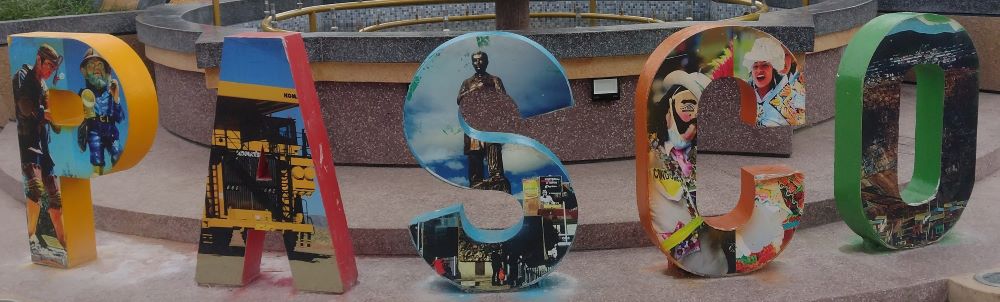
Cerro de Pasco, Perú has a population of about 59,000. Pasco is a mining town sitting at the top of the Andes Mtns, quite literally, at an elevation of 4330 meters (14,210 feet). I think of that white-capped mountain south of Seattle, Mt. Rainier, which is 14,410 feet, and try to compare - snow, ice, and glaciers on Mt. Rainier, at the same elevation in Perú is a city of close to 60,000 people. It's FRIGGIN' COld HERE! Some people think, and I saw a message posted on Facebook (a comment on something I posted) and the person wrote about all equatorial countries are hot. Apparently, he hasn't actually been to any equatorial countries, as I have now been in three of them, and I can tell you - Pasco is COLD, Bogotá is COLD, Quito is COLD. Being at the equator isn't the deciding factor in the temp, elevation is, and sitting on the equator, Quito sits at 2850 meters (9350 feet). Believe me, because I spent a week and a half in Quito, it's friggin' cold in that city. I also spent a week in Bogotá, 2640 meters/8660 feet, and it's very cold there, too. In another month or so I will visit La Paz, Bolivia, which sits at 3650 meters/11,975 feet, and I know it will be FRIGGIN' COLD. But, how can a person visit these countries and not visit those cities?
Read More
Huánuco, Perú
February 10, 2023

Huánuco, Perú: population: 236,000. Huánuco sits in a mountain valley at 1898 meters (6227 feet). It's a very pretty valley and quite close to the Amazon region. Huánuco was founded in 1539. The economy is based on sweet potatoes, beans, celery, cabbage, potatoes, cassavas, and many more vegetables, and many fruits including avocado, mango, bananas, papayas, oranges, lucuma, custard apple, guava, and more. Also, this area produces coffee, pineapple, coca, and sugar cane in the valleys. They also have mining, cattle ranching, oil production, and of course, commerce. The town has a large commercial center. As for interesting sites in the city, other than a couple of old churches there really isn't much of interest. Nothing to attract tourists, anyway. But, outside the city is a different story. One area of particular interest is "El Templo de las Manos Cruzadas" which means "The Temple of the Crossed Hands". It is also called The Temple of Kotosh. It is believed to be one of the oldest temples in the Americas, at about 4000 years old. A few kilometers south is the village of Huacar where you can find a church that dates back to about 1600 and routes to the archeological complex of Atash. You can also visit the Incan ruins and pre-Incan ruins in the area.
Read More