My Books on Amazon






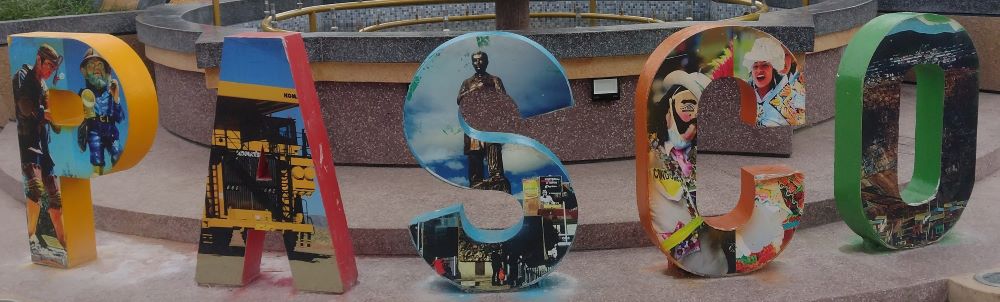
Cerro de Pasco
February 11, 2023
Cerro de Pasco, Perú has a population of about 59,000. Pasco is a mining town sitting at the top of the Andes Mtns, quite literally, at an elevation of 4330 meters (14,210 feet). I think of that white-capped mountain south of Seattle, Mt. Rainier, which is 14,410 feet, and try to compare - snow, ice, and glaciers on Mt. Rainier, at the same elevation in Perú is a city of close to 60,000 people. It's FRIGGIN' COld HERE! Some people think, and I saw a message posted on Facebook (a comment on something I posted) and the person wrote about all equatorial countries are hot. Apparently, he hasn't actually been to any equatorial countries, as I have now been in three of them, and I can tell you - Pasco is COLD, Bogotá is COLD, Quito is COLD. Being at the equator isn't the deciding factor in the temp, elevation is, and sitting on the equator, Quito sits at 2850 meters (9350 feet). Believe me, because I spent a week and a half in Quito, it's friggin' cold in that city. I also spent a week in Bogotá, 2640 meters/8660 feet, and it's very cold there, too. In another month or so I will visit La Paz, Bolivia, which sits at 3650 meters/11,975 feet, and I know it will be FRIGGIN' COLD. But, how can a person visit these countries and not visit those cities?
The hotel I'm in right at this moment has electric space heaters they rent for a little extra for those of us who can't handle the cold room. That's right, as cold as it is here, the general population, businesses, and hotels, have no heat. If they heat their space it's with space heaters of various kinds. Thankfully, they do have heated water in the shower (only).
Cerro de Pasco is a mining town and has been since silver was discovered in 1630. In 1816 water pumps were brought from England to pump the mines so the miners could go deeper. In the early 1800s, the Perúvian War of Independence shut down the mine from 1820 until 1825. There are three major, working mines in the area, and there have been some atrocious pollution problems because of the mining. The city has a plan to move the city but no action has been taken on that plan, yet. The city has a soccer stadium, of course, and being at this altitude, it is one of the highest-elevation stadiums in the world.
Pasco has an alpine tundra climate. Pasco is the largest city in the world with that classification. The average daytime high of 11° C (51° F), and the night average low of 0° C (31° F). The average annual temperature is 0° C (32° F). Pasco averages 916 mm (36 inches) of rain per year. They even, are you ready for this, in this equatorial city, receive snow occasionally. And, it can happen at any time of the year.
So, my impressions: There's not much in the city to attract tourists. Its calling card is its elevation and nothing more. So, if you get tired of the hot beaches or the warm Selva region (the area between the Andes and the Amazon), then pay a visit to Pasco, just be sure to bring winter clothes.
This is my goal: to find a new place to live. So to reach that goal I am traveling most of South America, visiting the countries of Ecuador, Perú, Bolivia, and Chile, passing through Argentina, visiting Paraguay, passing through a bit of Brazil, and finally visiting Uruguay. I have a list of towns, about 70, that meet these qualifications: Cities with average day temperatures of 22-28° C (72-83° F) and night temps of 14° C (57° F) and higher; and a population between 28,000-300,000. I analyzed climate and population data of around 700 towns in the countries mentioned above and then pulled out the ones that meet the previously mentioned criteria, which leaves about 70. My preference leans towards towns of less than 100,000 people. And, now that I have visited more than 30 towns/cities, I've decided I will probably want an inland town. I love the beach and walking in the warm water, but, getting sunburned is just too easy, even on a cloudy day. At least, here in Ecuador. I've also decided that any town with more than 100,000 population will be too big. I've decided that any small town/city (less than around 80,000 population) that meets the temp specifications and has a supermarket and ATM is one worth considering to live in.
My goal is to visit the towns and discover which one calls out to me - "Chip, Chip, make your new home here, this is your new home town". That hasn't happened yet, but there are four towns listed below that are very close to giving me that feeling. At any rate, I am not visiting tourist attractions or archeological sites, etc, those will have to wait for another trip through South America.
At this point in my journey I have three towns on my Top 10 list - Tingo Maria and Moyobamba, Perú, and Catamayo and Puyo, Ecuador. In my travels in Ecuador, I visited 31 towns/cities.
Next up: Satipo, Perú.

I used to teach English as a foreign language in Barranquilla, Colombia. Now I'm retired and traveling throughout South America.
I'm from Kennewick, Washington, USA. In my previous life, as I call it, I was an IT guy, systems administrator, computer tech, as well as a shipping/receiving guy and also worked as a merchandising guy in a RV/Camping store.