My Books on Amazon






There are 118 blog posts for you to enjoy.
Walking Thoughts: Arequipa, Arequipe, Birds, and Bread
August 7, 2026
I walk a lot.
At least twice a day, usually three times. Not for exercise exactly, though that's a bonus, but because walking does something useful to the mind. It loosens the bolts. It lets thoughts drift without demanding they arrive anywhere on time.
These walks are when I'm not thinking about my books. Which is precisely when the best thoughts tend to show up.
One walk recently meandered to birds.
Read MoreJuanjuí — A Selva Town That Just Works
March 17, 2026
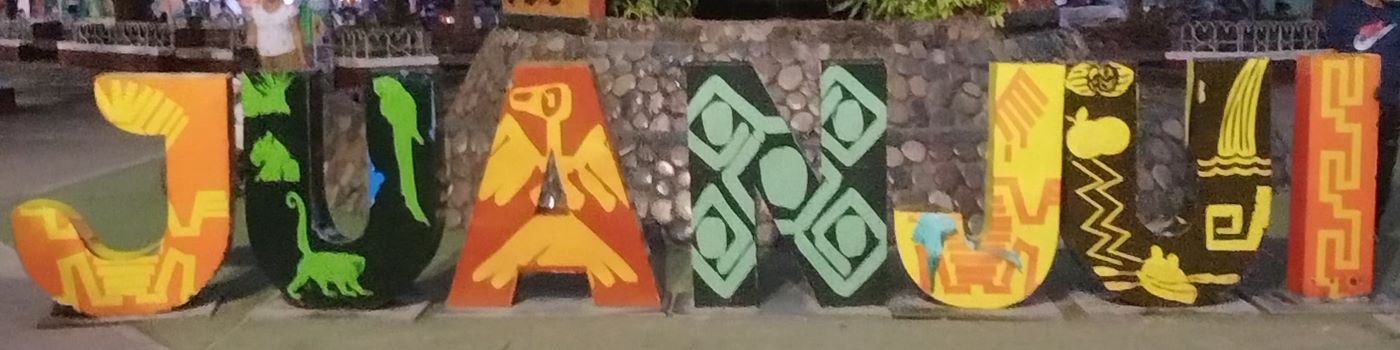
Juanjuí, Perú - I've been here several times before and I like this town. It has nothing special, no historical architecture, no archeological sites, no anything. It's just a riverside town that is calm, relaxing, full of friendly people. The streets are not congested, the drivers are not laying on their horns, in fact, they use them very sparingly. The main plaza is pleasant, and the linear park is mostly finished with new ponds with fountains and lots of open grass space. I've written other blogs about Juanjuí which include the history, so I won't bother with that in this blog.
References:
Juanjuí, Perú - Feb. 8, 2023
Juanjuí, Perú - Aug. 14, 2023
Lagunas — A 350-Year-Old Amazon Town Still Alive
March 13, 2026

Lagunas, Perú - population probably somewhere around 10,000 (depending on source, 7,000 - 15,000). It is located on the Huallaga River east of Yurimaguas. Yurimaguas is the end of the paved road in the Amazon region of north-eastern Perú. From Yurimaguas, you take a boat to Lagunas. Lagunas traces its origins back to 1670, when Jesuit missionary Juan Lorenzo Lucero founded it as Santiago de la Laguna. It was established near a natural lagoon and inhabited originally by local indigenous groups, particularly the Cocama and Cocamilla. This makes it one of the earliest mission towns in the Loreto Amazon, predating many better-known regional centers.
Reference: Loreto News Journal
Where the Highway Stops and the River Begins
March 9, 2026

I was in Moyobamba for about a week, and this was my fourth visit. I like Moyo, but as with my previous visits, the mototaxis are just overwhelming. I had this town on my list of possible new hometowns, but I've removed it. As much as I would love to live here, I can't. The noise and congestion, the chaos and stink, those mototaxis cause make it impossible for me to consider this as a new hometown.
After visiting Moyobamba, I spent 2 full days in Tarapoto. Not because I like it, but because the place I stayed - a 2-bedroom apartment - was quite nice. I've visited Tarapoto twice before, and it's never been on my final list of potential new hometowns. It's dirty - littered streets, sand/dirt in every street and building up and piling at every corner, chaotic traffic with those damnable mototaxis being the root cause. And it's quite hot, with high humidity, very uncomfortable, and sweaty.
Read MoreFinding the Quiet: Why My Shortlist for a New Home Ignores the Coast
March 5, 2026
What is it about coastal towns that makes them pretty much always "messier"? I'm talking specifically about these countries: Colombia, Ecuador, Perú, Chile, and Uruguay. The vast majority of interior towns are almost always cleaner, friendlier, prettier, etc.
I'm not imagining it. This pattern shows up everywhere I've been, and that includes 7 countries and over 300 towns/cities (in South America), and it’s not a cultural coincidence. It’s geography, economics, and human behavior piling up in the same places.
Here’s the straight, unsentimental anatomy of why coastal towns skew messier, while interior towns often feel cleaner, calmer, and more human. The comparisons below are to be taken with a very general understanding.
Read More
I used to teach English as a foreign language in Barranquilla, Colombia. Now I'm retired and traveling throughout South America.
I'm from Kennewick, Washington, USA. In my previous life, as I call it, I was an IT guy, systems administrator, computer tech, as well as a shipping/receiving guy and also worked as a merchandising guy in a RV/Camping store.