My Books on Amazon






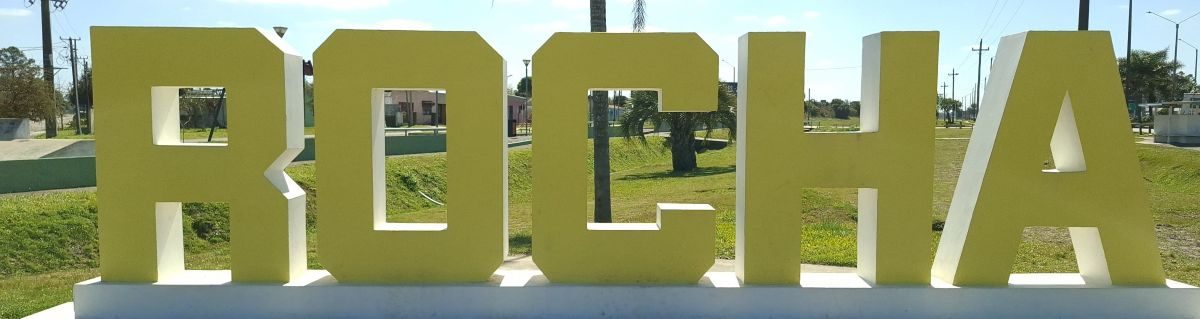
Rocha: Nothing to See Here? Look A Little Deeper
September 24, 2026
Rocha, UY
Rocha, Uruguay has a population of around 27,000. It was founded in 1793. There is nothing special here, nothing to draw tourists, so it is a town you would pass through. If nothing else, you might stop for a meal. Rocha is a pleasant town, a few nice parks and decent plazas, a couple of grocery stores, half-a-dozen ATMs. Rocha never became a major industrial city, a huge port, or a fashionable tourist destination. It remains primarily a regional administrative, commercial and service center. It's generally quiet. But does it have anything for tourists to see? No. But it has something much more unusual: an exceptionally intact example of an ordinary Uruguayan provincial city whose historical urban fabric was never completely erased.
Rocha is not interesting because it contains a few old buildings. The town itself is an unusually intact historical urban landscape. Rocha was planned from the beginning.
Rocha wasn't a little settlement that gradually grew into a town. It was deliberately created as part of Spain's late-colonial effort to populate and secure the eastern Banda Oriental against Portuguese expansion.
The first houses were actually standardized houses. A model house was constructed in Maldonado in 1792, and the design was then used for the new settlement. The basic house had a stone foundation, brick walls, a thatched roof, two rooms, and a separate kitchen. Twenty-three houses were built according to this general model. Twenty-two settler families occupied them in 1793.
And the town was laid out as a proper Spanish colonial grid, rather than developing organically around a road, river crossing, market, etc.
And the original urban geometry is still there.
In fact, something happened very recently that I suspect you would find particularly interesting: in 2026 the central urban layout of Rocha was declared a Monumento Histórico Nacional. The protected area is roughly bounded by Piedras, Leonardo Olivera, Lavalleja and José Batlle y Ordóñez. The national government specifically recognized the town's grid as an unusually significant example of urban planning derived from the Spanish Leyes de Indias and Enlightenment-era planning principles.
So when you're walking around thinking, "Why does practically this whole place look old?", you're seeing something real. The town's physical framework itself is now nationally protected.
And then there is the peculiar mixture of ages. This is where Rocha gets more interesting than a simple "colonial town."
You can find buildings representing roughly 230 years of continuous urban development in the same relatively small area.
The Intendencia's (Municipal Office) own walking circuit lists:
- the original colonial/founding houses
- the Ranchito de Pianni
- 19th-century residences
- the 1896 Llana building
- the 1902 Sociedad Italiana
- the 1906 public school
- the 1908 Hotel Arrarte
- the 1909 municipal building
- the 1909 electrical plant
- the 1910 Teatro 25 de Mayo
- numerous turn-of-the-century residences and commercial buildings and later modernist buildings, including an important work by Uruguayan architect Eladio Dieste.
So what you see isn't one architectural period preserved as a museum piece. It's layer upon layer of a living town.
The turn-of-the-century building boom was surprisingly substantial
Around 1900, Rocha was experiencing a substantial private construction boom. The municipal historical material gives a wonderfully concrete figure:
In 1900 there were 28 houses under construction in the principal part of Rocha, employing 11 builders, 27 skilled workers and 64 laborers, plus people working in quarrying, carpentry, ironwork, transportation, etc.
That's a lot of construction for a relatively small provincial town. And this is an important point: this wasn't initially a government building program.
The Intendencia's historical account says that until around 1900, most significant construction was privately financed. The government generally rented existing houses rather than constructing its own buildings. Wealthier residents were building substantial homes and commercial premises for themselves.
The residences of families such as Demichelli and Llana are specifically identified as examples of this period.
So the impressive old facades you're seeing aren't necessarily evidence that Rocha was once some grand governmental center. They're evidence of a period when private residents had enough money and confidence to build substantial houses and businesses.

I used to teach English as a foreign language in Barranquilla, Colombia. Now I'm retired and traveling throughout South America.
I'm from Kennewick, Washington, USA. In my previous life, as I call it, I was an IT guy, systems administrator, computer tech, as well as a shipping/receiving guy and also worked as a merchandising guy in a RV/Camping store.