My Books on Amazon






Chuy: Shopping. Punta del Diablo: Beaches. That's About It.
September 20, 2026
My travels through Rocha Department took me to two towns that couldn't be much more different. Chuy sits directly on the Brazilian border and is primarily a place for shopping and crossing between countries. Punta del Diablo is a small fishing and beach town that becomes a major vacation destination during the summer. Neither one is particularly remarkable in itself, but both were interesting enough to deserve a closer look.
Chuy, UY
Chuy is a small border town in Uruguay’s Rocha Department, directly opposite the Brazilian town of Chuí. The international border runs along Avenida Internacional, so you can walk between the two countries while the language, currency, shops, and atmosphere change from one side to the other. Spanish and Portuguese—and a local mix often called portunhol—are common in daily life.
The town itself is more practical and commercial than picturesque: it is a useful stop for travelers crossing the Uruguay–Brazil border, buying supplies, or exploring Rocha’s coast. For beaches and scenery, Barra del Chuy, La Coronilla, and the Santa Teresa area are generally more appealing; for shopping and the cross-border experience, central Chuy is the main draw. Uruguay’s side has numerous duty-free shops, some of which are quite large, and all have an almost endless variety of perfumes and cosmetics, clothing, alcohol, TVs and computers, and other imported goods. The Brazilian side has mostly supermarkets and everyday commerce.
The coast and beaches are a short distance from town, about a 15-minute drive. Also, outside of town is an old fort, about 8 km west of town, from the colonial era - Fuerte San Miguel (1737). And 36 km south of Chuy is Fortaleza de Santa Teresa, which dates to 1762. Those, the beach, and the many duty-free stores are the attractions for tourists.
Punto del Diablo, UY
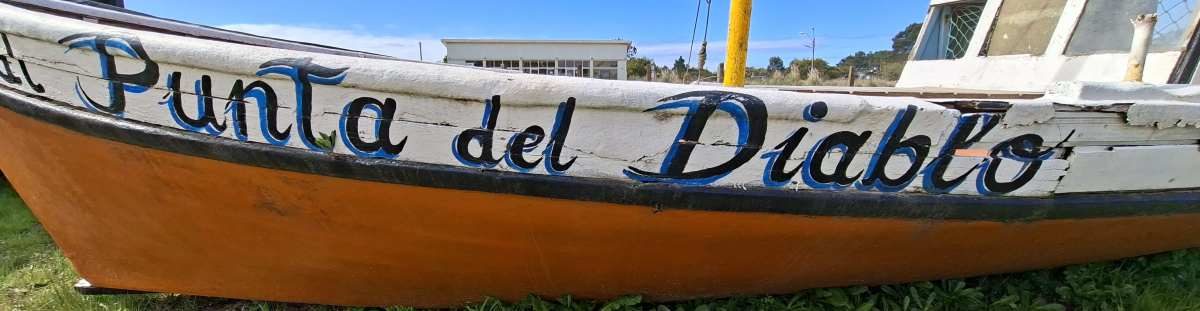
Punto del Diablo is a beach village with a population of less than 1000, but during the summer high season, it swells to 25,000. People from Montevideo and Buenos Aires to the south and the coast of Brasil northward have homes here or vacation here.
The poorly written Wikipedia page makes it sound much bigger or grander than it really is. Yes, it's interesting and pleasant to visit, but the number of stores/shops, etc is not what you might expect after reading that page. There are three mini-markets, no big grocery store. There's no bank, but there is one ( 1 ) cash machine, and it's located in the mini-market near the beach, called Supermercado Sandra 2. It's not really a "super" mercado; it's a minimarket. In Google Maps, if you look at the street view, you can see the ATM, but that picture is old. Now, if you walk by, you'll miss it, as I did. Why? Because somebody has plastered small stickers over the windows. As in, almost entirely covered the windows in all kinds of stickers. I guess some local kid(s) got bored.
The beaches are nice, though. There are 3 rocky stretches that separate them. You'll find Playa del Rivera right at the edge of town. Then between town and the lighthouse, to the south, is Playa de la Viuda, and just beyond that, to the south, is Playa Santa Maria. Oh, "playa" is "beach" in English. In the rocks between Playa Santa Maria and Playa de La Viuda is a whale carcass. It originally washed up on Playa Santa Maria, but the tide eventually moved northward around the point and into the rocks of Playa de La Viuda, in front of the lighthouse. The lighthouse is not open to the public. The whole place is privately owned and rented for vacationers. During the off-season (right now) it goes for US$200 per night. I found a cabin (there are lots of cabins for rent) just outside of the "downtown" area for 1300 pesos per night (as of today, about US$32 per night). So far, having visited 7 towns in UY on this journey, this is the cheapest place, hotel/hostel/cabine/etc, that I have found. Pretty crazy considering the other places I've been to were not tourist locations by any stretch of the imagination. But, during the high season, November - February, you can expect the prices to double. Otherwise, should you add Punta del Diablo to your must-visit list for Uruguay? Maybe not as a must-visit, but certainly as a pleasant option if you're traveling the coast.

I used to teach English as a foreign language in Barranquilla, Colombia. Now I'm retired and traveling throughout South America.
I'm from Kennewick, Washington, USA. In my previous life, as I call it, I was an IT guy, systems administrator, computer tech, as well as a shipping/receiving guy and also worked as a merchandising guy in a RV/Camping store.