My Books on Amazon






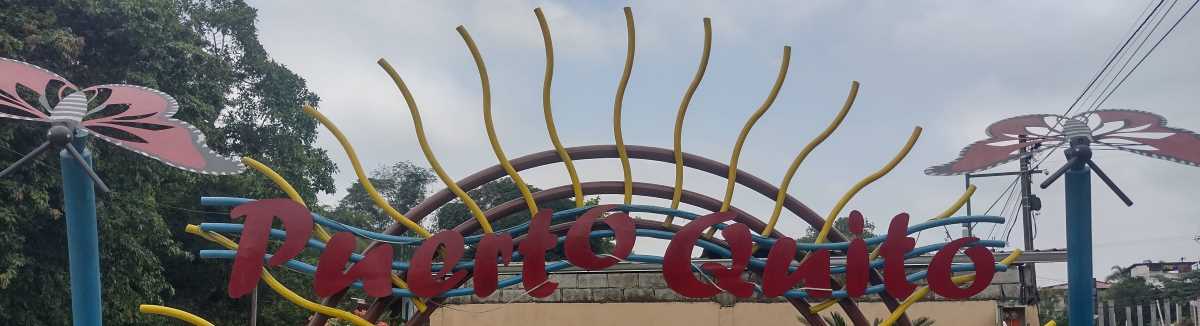
Puerto Quito, Ecuador
September 8, 2025
Querto Quito is not in the Quito area, it's 140 kilometers (87 miles) away from Quito. Anyway, Puerto Quito has a population of less than 5,000 in the urban area, and the parish about 25,000. Puerto Quito sits just inside the western side of the Andes Mountains in northern Ecuador. It's a very nice little valley with Rio Caoní running alongside. The entire business district area of the town is about four blocks by four blocks. That's quite small, but it is a pleasant town, and on weekends the town center is full of people. There's a riverside park where you can swim in the river, but if you're not in the water you're going to get eaten by midges (tiny biting flies), so wear long pants. The town sits at only 135 meters above sea level, so while it is in the mountains, it's still very low, giving it a very pleasant temperature range, though the humidity does get quite high, as expected.
Wikipedia
History
The town is not old, dating back only into the 1960s and officially recognized as a town in 1996. The name "Puerto Quito" is derived from the assignment given by the scientist from Riobamba, Pedro Vicente Maldonado, during one of his incursions in 1740 to this area, baptized as "Puerto de Quito." He sought, thus, to establish a short route between the city of Quito and the Pacific Ocean. This region was known at the beginning of the colonial era as the "Yumbos Province" and was inhabited by the Niguas, the Yumbos and the Tsáchilas; its territories, almost entirely unexplored. By the 18th century, the area entered a period of reduction and withdrawal of its native inhabitants. For part of the 19th century , the area was completely uninhabited. Then in the 1960s, new settlers arrived. The only way to get here was by river using canoes. The town was officially founded in October 1973 by the settlers who made their homes there. In March 1989 it was formally recognized as a parish—a local administrative district within a canton, somewhat like a township in the U.S. though there’s no exact equivalent. A few years later, in April 1996, it was elevated to the status of a canton, the Ecuadorian equivalent of a county.
Wikipedia
Tourism and what to do in and around Puerto Quito
The town's reputation as a tourist destination has been growin significantly in recent years, all related to eco-tourism and adventure sports. The most notable tourist destinations are:
- Blue Waterfall: Located in the "Grupo Mieles" area, it is formed by the Culebra River and has a 15-meter (49 feet) drop. The water, as it falls, forms an emerald-colored pool.
- Macallares Waterfall: Located near the "Tierra Santa" site, it is formed by the river of the same name and has a drop of 4 meters (13 feet) and another of 1 meter.
- The Cascada del Silencio is located in the community of Santa Fe. Behind the waterfall are caves inhabited by so-called “night swallows” (golondrinas nocturnas)—the local name for oilbirds, nocturnal cave-dwelling birds found in this region.
- "La Playita" Spa: Located in the "13 de Julio" neighborhood, you can practice various water sports; it also has an island with local flora and fauna.
- Río Blanco: This is one of the area's main attractions, although in some areas it has a very large flow. Its main attraction is the "Steam Stone," a rock that generates steam when water hits it.
The town has a moto-cross track just outside of town, and nature reserves that have no trails, at least, no trails I could find. From what I saw, if you really wanted to venture into the jungle you would need a machete to get into and through it. That particular reserve, called Parque Ecológico Puerto Quito, in Google maps, has pictures of cyclists but where they are in those pics I could not find.
My Impressions
Puerto Quita is actually a pleasant town to visit. I spent four days here in the Hotel Petate. They have a few cabins, no hotel rooms. It's very nice, especially for the price, only 22 dollars a night. The town itself is clean and generally quiet. The noise comes from the idiots who have to ride their motocycles as fast as possible through town to get attention. There are a few of those stupid moto-taxis here, but here in Puerto Quito, those ridiculous machines have properly functioning mufflers. The town plaza is quite nice and from what I saw never crowded. The town has about a half-dozen ATMs which is much more than typical for a town of less than 5000 population. But, the one bank, a small local bank, would not change the 20-dollar bills for smaller bills. Having only 20s can be a problem when lunch costs $4 and the restaurant doesn't have the change. So, what do they do? One of the employees goes along the street to the other businesses asking to change the 20 for small bills. It always works out, but it sure is an inconvenience, for them and yourself. But, this is typical is the small towns with limited banking services. Overall, I like Puerto Quito. Should you visit? If you want to explore the waterfalls, yes. Otherwise, stop by for lunch on the trip from Quito to the coast and walk the downtown, you'll like it.

I used to teach English as a foreign language in Barranquilla, Colombia. Now I'm retired and traveling throughout South America.
I'm from Kennewick, Washington, USA. In my previous life, as I call it, I was an IT guy, systems administrator, computer tech, as well as a shipping/receiving guy and also worked as a merchandising guy in a RV/Camping store.