My Books on Amazon






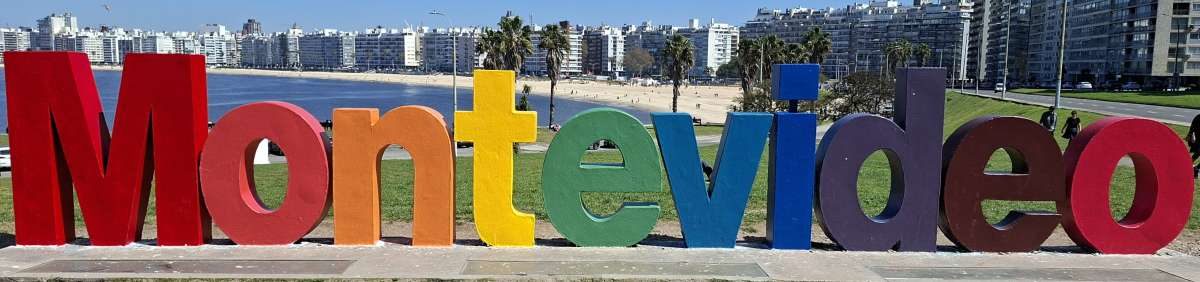
Montevideo: A City Full of Surprises
October 2, 2026
One of the best things about traveling without a rigid itinerary is that a city can surprise you. You arrive with a general idea of what to expect, and then you start walking. Before long, you discover that the city you imagined and the city you're actually seeing aren't quite the same thing.
Montevideo has surprised me several times.
The first surprise is the architecture. I expected old buildings in Ciudad Vieja, some newer buildings in the downtown area, and the usual mixture that comes with a city that has been around for a few centuries. What I didn't expect was the sheer variety. Montevideo's architecture reflects different periods and the influence of the many immigrant populations that helped shape the city. The city's own tourism material points out that the architecture ranges from colonial and neoclassical to Neogothic, modernist, eclectic, and Art Deco. Montevideo also has one of the largest concentrations of Art Deco architecture in the world.
But statistics about architectural styles don't really prepare you for walking down one particular street.
On one side of the street, I came across three houses with curved balconies and round windows. They looked almost nautical, as if an architect had been thinking about ocean liners rather than houses. Then, just across the street and a couple of houses farther along, were three buildings that looked as though someone had picked them up in Austria or Germany and dropped them into Montevideo.
And that wasn't some carefully arranged architectural exhibition. They were simply houses on an urban residential street.
That's what makes walking around Montevideo so much fun. You don't necessarily have to find a particular landmark. Sometimes the interesting building is the one you weren't looking for. What I do is walk along a street, and when I come to a cross street, I pause, look in both directions at what's there, and choose which direction to go. You'd be amazed by what you can find if you pause and look.
The city's history helps explain some of this. Montevideo began as a Spanish military outpost, and its colonial city was surrounded by substantial defensive walls. Construction of the fortifications began in the eighteenth century, and the walls were largely demolished beginning in 1829 as the city expanded beyond them. The old city was no longer going to be a fortified enclave. It was going to become an open city.
You can still find pieces of that old Montevideo, although you have to know where to look. The most obvious survivor is the Cubo del Sur, part of the old defensive system. But even that has been hidden behind stone blocks to keep it from deteriorating further. Other remains are scattered through Ciudad Vieja and along the waterfront, including archaeological remnants of the old walls. The Museo de las Migraciones contains some of the most extensive surviving archaeological remains of the colonial fortifications.
I walked along Rambla Francia looking for remnants of the old fortifications. There isn't a great stretch of original wall sitting there waiting to be photographed. Much of what survives is underground, incorporated into later construction, or visible only as archaeological remains. At one point I was walking toward what looked like an old chimney and wondered whether it might have something to do with the old defenses. It turned out to be something considerably less romantic: a nineteenth-century ventilation shaft associated with Montevideo's sewage system.
That, too, is part of walking through an old city. Sometimes you find a fortification. Sometimes you find a sewer chimney.
Another surprise has been the plazas.
This one isn't necessarily a pleasant surprise.
I've seen much nicer plazas in towns considerably smaller than Montevideo. Some of the main plazas in the downtown and historic areas seem almost like afterthoughts. They aren't terrible, but they can be remarkably plain and underwhelming considering the buildings and history surrounding them.
Plaza Constitución, Plaza Matriz, Plaza Independencia, and Plaza Cagancha all have important places in the history of the city, but I keep finding myself looking beyond the plaza itself to the architecture around it. Plaza Independencia, for example, was laid out in 1837 after the colonial fortifications were demolished. The enormous Ciudadela once occupied part of what is now the plaza. Today the space is dominated by the monument to José Artigas and the reconstructed gateway of the old Ciudadela. It is supported by modern stone blocks so it doesn't fall.
Plaza Cagancha has an equally interesting history. It was established in 1836 as the central plaza of the new city that was developing outside the old walls. It later became surrounded by some impressive buildings, and today it marks kilometer zero of Uruguay's road system.
But aesthetically, I sometimes find myself thinking that Montevideo has essentially said, "Here is your historic plaza. Please don't expect too much from the landscaping." Perhaps the reason is that Montevideo has another kind of public square, one that is several kilometers long.
The Rambla.
The Rambla is one of the defining features of Montevideo. Beginning in the early twentieth century, the city undertook a series of projects to reshape and develop its waterfront. The construction of the Rambla Sur, in particular, dramatically altered the coastline, including the filling and reshaping of sections of the shore. The project also eliminated the Bajo, a poor waterfront neighborhood that city officials considered undesirable, and displaced many of its residents. The completed waterfront became one of Montevideo's characteristic public spaces.
And once you spend some time walking it, you understand why it matters.
The Rambla isn't just a road beside the water. It is a place to walk, sit, exercise, fish, talk, watch the water, drink mate (mah tey) or terere, and watch the clouds float by and the water lap against the shore. It gives Montevideo something that many cities don't have: an enormous public space that belongs to everyone and doesn't require a special occasion to use.
It also gives the city some spectacular views. Walking along the waterfront, I found myself thinking about something that would probably seem like a trivial geographic question until you actually start considering it: where can a person stand at sea level and see both the sunrise and sunset over water?
Montevideo itself isn't quite the answer. Its coastline generally faces south and southeast, so the water is especially well positioned for sunrise views. For sunset, the sun moves toward the western horizon behind the city and land.
Piriápolis, farther east along Uruguay's coast, is a different story.
Piriápolis is another place that surprised me, although in a completely different way. It's a beach resort town of roughly 13,000 people that becomes much larger during the summer. Its unusual geography, with the coastline curving around the town, means that you can experience both sunrise and sunset over the water from the same general coastal area.
The town itself is another example of how European ideas were transplanted and then transformed in Uruguay. Francisco Piria conceived Piriápolis as a resort inspired by the great European Belle Époque resorts. He purchased thousands of hectares between the hills and the sea and began developing what he called the "Balneario del Porvenir," or resort of the future. The first Hotel Piriápolis opened in 1905, work on the Rambla began in 1910, and the development of the resort continued through the following decades.
The centerpiece eventually became the enormous Argentino Hotel, which opened on December 24, 1930. At the time it was regarded as one of the largest and most luxurious hotels in South America, and much of its equipment and furnishings were imported from Europe.
Piriápolis therefore has its own architectural personality, but it also illustrates something that becomes increasingly apparent as you travel around Uruguay. This country has absorbed an enormous amount of European influence without simply becoming European. The result is something distinctly Uruguayan, even when the ingredients came from somewhere else.
That may be the best way to describe Montevideo as well.
It is an old Spanish colonial city that tore down its walls and grew into a modern port. It has Italian, Spanish, French, German, and other European influences mixed together. It has grand public buildings, Art Deco apartment houses, ordinary little homes, remnants of military fortifications, and a waterfront that has become one of its most important public spaces.
And then there are the things you simply stumble across.
A house that looks like an ocean liner.
A house that looks like it belongs in Austria.
A piece of an eighteenth-century fortification.
A nineteenth-century sewage chimney.
A plaza that leaves you wondering why they didn't do more with it.
And a waterfront where you can walk for miles while the Río de la Plata stretches out beside you.
That's probably what I have enjoyed most about Montevideo. The city doesn't reveal itself all at once. You have to walk it. And when you do, it keeps producing little surprises.

I used to teach English as a foreign language in Barranquilla, Colombia. Now I'm retired and traveling throughout South America.
I'm from Kennewick, Washington, USA. In my previous life, as I call it, I was an IT guy, systems administrator, computer tech, as well as a shipping/receiving guy and also worked as a merchandising guy in a RV/Camping store.