My Books on Amazon






What Vonnegut Was Really Saying
December 24, 2025
When I read this quote it didn't make sense to me, and the fact that it's been attributed to Vonnegut also couldn't be correct, so I thought -
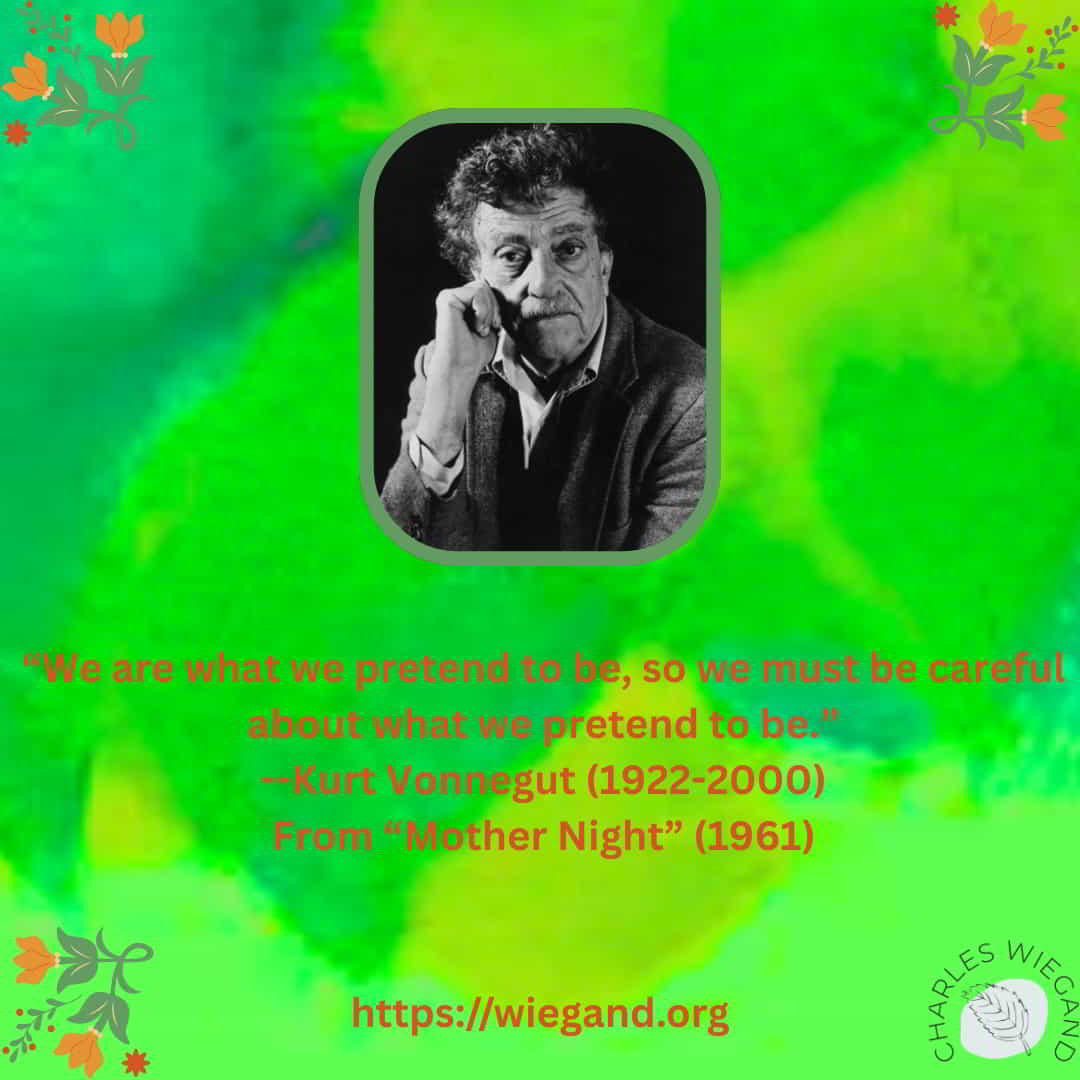
“We are what we pretend to be, so we must be careful about what we pretend to be.”
--Kurt Vonnegut (1922-2000)
From his book Mother Night (1961)
This is how I interpreted it - every day we see people on social media pretending to be "socialites" or somehow richer or better off than they are, pretending to be specialists, yet they are not those things in reality - they are fakes. After learning what the quote means, the context around it, I was actually circling the quote’s point, and that point kind of sneaks up on you sideways.
No, it’s not saying “pretending makes you authentic.” It’s saying the opposite, and doing it with a warning label, as you'll see below.
This is what it means:
If you pretend to be something long enough, you don’t just fool others. You start rewiring yourself. Vonnegut isn’t defending fakes. He’s warning about them.
What “pretend” means here, and this is the key, he’s not talking about:
- playful imagination
- fiction
- trying on roles
- aspirational growth
He’s talking about performative identity. Acting a role publicly, repeatedly, until it becomes your behavior, your habits, and eventually your moral footprint. As in: Not who you are on the inside, but rather - who you practiced being becomes who you are on the outside.
Here's why my social-media example actually proves the quote
Those social media “socialites,” “experts,” and “success stories”? They may be fake financially or credential-wise, yes. But Vonnegut’s point is darker:
- If you act superior long enough, you become disconnected.
- If you perform expertise long enough, you stop learning.
- If you pretend to be wealthy or powerful, you start valuing image over truth.
At that point, the pretending isn’t harmless anymore. It becomes identity drift.
They are, functionally, becoming what they pretend to be: not rich, not experts — but people who live by deception.
His book, Mother Night is literally about a man who pretends to be a Nazi for years and then has to face an unbearable question: “If I acted like a monster every day… what does that make me?”
Vonnegut’s answer is brutal and unromantic: Your actions define you, not your private excuses.
The line rewritten in plain English:
“Don’t shrug off dishonesty just because you call it an act.
Acts harden into habits.
Habits harden into character.”
The "warning label" I mentioned at the top
So yes — those online fakers? They’re not “just pretending.” They’re practicing a version of themselves. And Vonnegut would absolutely say: Practice carefully.
To sum it all up, no fluff, no preaching voice:
Kurt Vonnegut once warned: “We are what we pretend to be, so we must be careful about what we pretend to be.”
He wasn’t defending fakery. He was warning about it.
Pretending isn’t harmless when it’s done daily, publicly, and as a persona. When someone performs wealth, expertise, success, or superiority long enough, it stops being an act and starts shaping habits, values, and behavior.
You don’t become rich by pretending to be rich. You become someone who lives by appearances.
Vonnegut’s point is simple and uncomfortable: repeated behavior, even when it’s “just an act,” becomes identity. Not in theory. In practice.
Careful what you rehearse. You may wake up one day and realize you became it.
Kurt Vonnegut has a famous name, yet I knew nothing about him. I don't remember learning anything about him in all my school years, so I looked him up, and this is what I discovered:
Who was Kurt Vonnegut?
Vonnegut stood for human decency in a world that keeps trying to grind it into dust. Here's a little longer answer, stripped of the classroom version:
What shaped him
Vonnegut survived the firebombing of Dresden as a POW in WWII. Tens of thousands of civilians died. That experience permanently rewired his brain. After that, he did not trust:
- war
- power
- nationalism
- tidy explanations for human cruelty
Everything he wrote flows from that.
What he believed, put simply:
- War is obscene, no matter how noble we dress it up.
- Technology without ethics is dangerous. Smart machines don’t make people smarter.
- Authority deserves suspicion, especially when it claims moral certainty.
- People are fragile, ridiculous, lonely creatures who mostly want to be loved and not hurt.
- Kindness matters more than ideology.
He didn’t believe humans were good. He believed humans were pitiful — and therefore deserving of mercy.
His core beliefs/morals
Vonnegut was a humanist. No grand religious answers, no cosmic justice. Just this:
We’re stuck on this planet together. Try not to be a jerk.
He believed pretending, lying, or hiding behind roles (soldier, hero, patriot, genius, boss) is how people excuse evil. Hence that quote above. He cared deeply about personal responsibility — what you do, not what you claim to be.
Why he used dark humor and sci-fi
Because reality was already horrifying. Science fiction let him:
- exaggerate human stupidity
- expose systems of power
- say unbearable truths with a grin
The jokes are bait. The punchlines usually land somewhere in your stomach.
If you had to sum him up in one sentence
Kurt Vonnegut believed the world is absurd, cruel, and broken, but that kindness, honesty, and humility are still worth choosing anyway.
Not optimistic.
Not cynical.
Clear-eyed — and stubbornly humane.

I used to teach English as a foreign language in Barranquilla, Colombia. Now I'm retired and traveling throughout South America.
I'm from Kennewick, Washington, USA. In my previous life, as I call it, I was an IT guy, systems administrator, computer tech, as well as a shipping/receiving guy and also worked as a merchandising guy in a RV/Camping store.