My Books on Amazon






Consistency Isn't Integrity
December 10, 2025
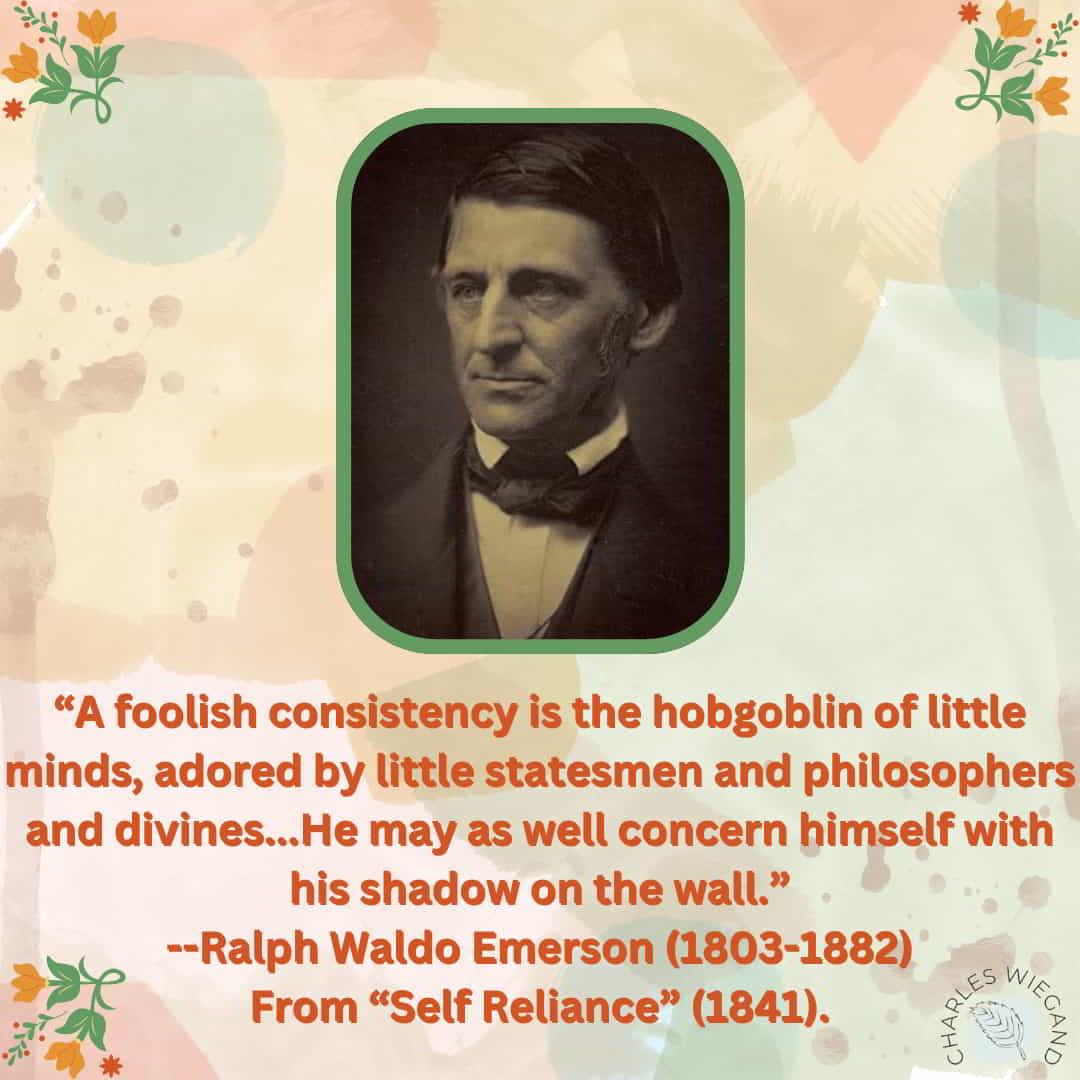
"A foolish consistency is the hobgoblin of little minds, adored by little statesmen and philosophers and divines...He may as well concern himself with his shadow on the wall."
--Ralph Waldo Emerson (1803-1882)
From "Self Reliance" (1841)
Emerson's line hits with a kind of quiet ferocity. He’s not gently suggesting that people should loosen up, he's flat-out mocking the idea that rigid consistency is a virtue. To him, clinging to an old opinion just because you once said it is about as meaningful as worrying about your own shadow on the wall. It's a performance, not a principle. He isn't criticizing consistency that grows naturally out of clear thinking; he's going after the kind that's powered by insecurity - the fear of looking wrong, changing course, or admitting you've learned something.
The heart of his argument is this: a thinking person evolves. A growing person contradicts themselves. A brave person risks being misunderstood, mocked, or accused of "flip-flopping." Emerson believed that true integrity means listening to your present mind, not locking yourself to the past. If yesterday you believed X, but today you've learned enough to believe Y, he'd say the honest thing to do is admit the change openly. To Emerson, refusing to evolve isn't admirable, it's cowardice disguised as reliability.
In the quote, he's not condemning all consistency, only the kind where people:
- Refuse to evolve
- Fear contradicting themselves
- Prioritize reputation over truth
In today's world?
And, honestly, look around today and you see exactly the kind of "foolish consistency" he was railing against. In politics, media, and even everyday life, people are punished for growth. Change your mind? Flip-flopper. Learn something new? Hypocrite. Show signs of evolution? Unreliable. We live in a world that demands people freeze themselves in time, never daring to update their beliefs. Emerson would roll his eyes so hard he'd see his own soul. Yes, a lot of people do push for absolute consistency, especially in politics, media, or leadership:
- "But you said this five years ago!"
- "You flip-flopped!"
- "You're inconsistent!"
In the end, his point is simple but surprisingly radical: your job is not to remain who you were, it's to become who you are. Consistency for its own sake is the enemy of that process. Growth requires contradiction. Real integrity requires motion. And a mind that refuses to evolve might as well be, as he put it, a hobgoblin's little playground.

I used to teach English as a foreign language in Barranquilla, Colombia. Now I'm retired and traveling throughout South America.
I'm from Kennewick, Washington, USA. In my previous life, as I call it, I was an IT guy, systems administrator, computer tech, as well as a shipping/receiving guy and also worked as a merchandising guy in a RV/Camping store.