My Books on Amazon






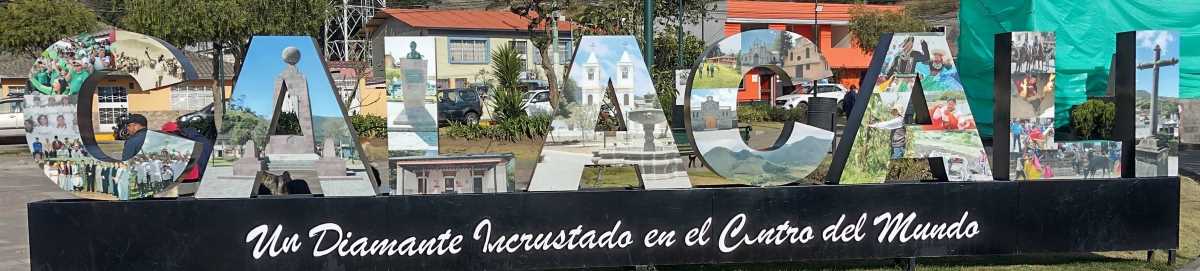
Calacalí, Ecuador
September 17, 2025
Calacalí is a small town on the northwestern edge of Quito’s canton, population somewhere around four thousand. It’s a gateway town — the last flat before the road shoots up toward the cloud forests and eventually Mindo. The surrounding hills connect into the Chocó Andino, with Pululahua’s volcanic crater and Yunguilla’s misty forests not far off. The place has deep roots, once home to the Yumbo people before the Spanish dragged their sugar mills and trapiches into the valley. Today, it’s a sleepy little town with a couple of plazas, murals splashed on walls, and the kind of laid-back pace that makes you forget the capital is less than an hour away.
History and Curiosities
The name “Calacalí” may come from the lime (“cal”) mined here and used to build colonial Quito, or from an indigenous description of the regular white mist that covers the valley. Either way, the town has been on the map a long time. It’s also the birthplace of Carlota Jaramillo, the legendary singer known as the Queen of Pasillo, whose childhood home is now a museum. And Calacalí has one other claim to fame: the original monument marking the equator, built in 1936 — years before the tourist machine in San Antonio de Pichincha got its giant globe and ticket booths. Here, it was just a stone obelisk with a small globe on top, sitting in the town square, no fuss about it. But, when I was here, it was surrounded by green tarps, apparently undergoing renovations. So, I couldn't get any pics of it.
The Great Invisible Monument
When I arrived, I walked that very square, circling the park, phone out, snapping murals and streets. I was also hunting something practical: a bed for the night. After asking a handful of locals — corner conversations, tienda chats, even the police station — I was told the same thing over and over: nope, there are no hotels here. Out of nearly 300 towns I’ve visited across South America, Calacalí is the first with absolutely zero rooms for travelers. Not one. Unbelievable. So I focused on that, scanning the streets for hospedaje signs, and I didn’t notice anything that hinted at the equator line.
Turns out, I wasn’t blind — the monument was literally tarped off. In the middle of the plaza sat a renovation zone surrounded by green plastic. Behind it? The humble little obelisk that once marked the world’s midline. The irony wasn’t lost on me: I was standing in the town that birthed Ecuador’s equator tourism, but the 1936 landmark itself was hidden behind construction tarps, invisible to anyone passing through. Only in Ecuador could the middle of the world be under wraps, and nobody thinks to mention it.
What You’ll Find (and What You Won’t)
Walk around Calacalí and you’ll see murals, small shops, and the rhythm of daily life in a place that doesn’t really expect visitors to stay. You’ll also see the parks — one of which hides the original equator monument if you’re lucky enough to find it uncovered. What you won’t see are hotels, hostals, residencias, or even a modest room-for-rent sign. Travelers get funneled down the road to San Antonio (Mitad del Mundo) where the tourist industry has bloomed, leaving Calacalí as a pass-through. It’s a quirky oversight, because the town does have history, culture, and geography worth pausing for. Just don’t expect to find a bed when the sun sets.
My Takeaway
Calacalí is one of those towns that proves the map can lie. On paper, it has heritage, monuments, scenery — all the makings of a tourist stop. On the ground, it’s murals, parks, a grocery run, and then you move on. I left by taxi to San Antonio, shaking my head at the idea that a town with the original equator monument has zero accommodations for visitors. But maybe that’s the point. Not every place is meant to be a destination; some just want to stay what they’ve always been — a quiet stop on the way to somewhere else. Kind of poetic, really: Calacalí calls itself “Un Diamante Incrustado en el Centro del Mundo” (a diamond embedded in the center of the world), yet its actual equator monument is invisible under tarps. The middle of the world... under wraps.

I used to teach English as a foreign language in Barranquilla, Colombia. Now I'm retired and traveling throughout South America.
I'm from Kennewick, Washington, USA. In my previous life, as I call it, I was an IT guy, systems administrator, computer tech, as well as a shipping/receiving guy and also worked as a merchandising guy in a RV/Camping store.