My Books on Amazon






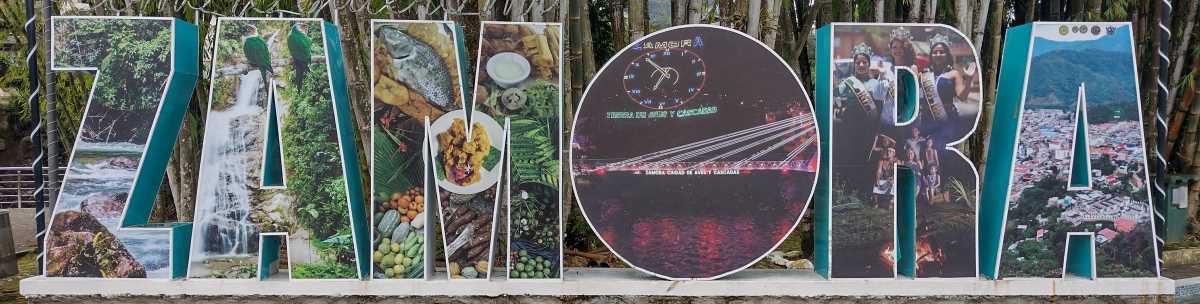
Zamora, Ecuador
August 15, 2025
Zamora, Ecuador, population about 18,000, founded in 1549. Don't expect to find any colonial architecture here, there isn't any. I save a handful of buildings/houses in the area that might be around 100 years old, but that's the extent of old architecture. The city sits at 920 meters (3018 feet) of elevation. This was my second time visiting Zamora. I like this town. It sits in a beautiful little valley and has two rivers that meet here in town. The one drawback to this valley is the rain - of the two visits here, a total of 8 or 9 days, it rained every day or night. But then, this is the Amazon region, and in the Andes Mountains, so that is to be expected.
The World's Biggest Clock, and it Works!
One of Zamora's big claim's to fame is it clock, they say it the biggest in the word at 30 meters (98 fee) in diameter. It's part of a hillside at the edge of downtown, you can't miss it, especially at the top of the hour when it start about 20 seconds of music, so loud it can be heard throughout the entire valley. After the music, it chimes. They say it is accurate within 1-2 minutes per year. There are pictures in the photo album.
The Malecon Riverside Park
I wrote a blog for the first visit here, it's on this site, and it includes some of the town's history, so I won't rewrite any of that. The town has a very nice malecon park. There are three 3-story view towers, and a foot bridge to the other side. There's another tower on the other side.
No Moto-taxis - Oh! Hallelujah!
Being that the town sits just inside the Amazon Rain Forest, there are opportunities for excursions further into the Amazon. This region is beautiful. I love "La Selva" (the jungle) of both Ecuador and Perú. Another point about this side of the mountains of Ecuador that, to me, is very important - no moto-taxis, those obnoxious air and noise pollution machines I desperately hate. Unlike pretty much all of Colombia and Perú where they have those stupid machines, here without them - the towns are much more tranquil, the traffic flows well, there's almost no horn-honking, and less air pollution when walking the narrow inner-city streets. This is the main reason why I have decided that Moyobamba, Perú, will not be my future new hometown - thos damn moto-taxis. I'll settle down here in Ecuador, and probably on this (Eastern) side of the Andes.
So, up above I wrote I'd include no history this time, that was a lie. I came across some interesting history that I hadn't found for the previous blog. Here it goes if you want to read some interesting history -
Zamora, Ecuador's History and why it has no historical buildings
Zamora’s “founded in 1549” line is true on paper, but the short version is: it didn’t stay a colonial town for long, and the jungle + 20th-century growth did the rest. Here’s the why:
Founding (1549/1550): Spanish expeditions hit the area in 1548–49; the city known as Zamora de los Alcaides was founded around Oct 4–6, 1549—often attributed to Hernando de Barahona with Alonso de Mercadillo and Hernando de Benavente (some accounts credit Mercadillo in 1550—historians disagree).
References:
https://en.wikipedia.org/wiki/Zamora-Chinchipe_Province
https://es.wikipedia.org/wiki/Zamora_de_los_Alcaides
https://www.persee.fr/doc/bifea_0303-7495_1981_num_10_3_1538
https://pdfcoffee.com/el-mosaico-indigena-68pdf-pdf-free.html
Brief mining boom: Mid-1500s, Zamora had a gold-driven upswing (a 1567 report counts 26 Spanish households—more than Loja at the time). Then the shine faded.
References:
https://pdfcoffee.com/el-mosaico-indigena-68pdf-pdf-free.html
Abandonment: Within ~50 years the settlement was effectively lost; Shuar resistance toppled Spanish outposts across the region by the late 1500s (notably 1599). That’s why you don’t see streets of 16th-century houses today.
References:
https://ec.viajandox.com/zamora-chinchipe/historia-de-zamora-chinchipe-PVP60
https://revista.drclas.harvard.edu/territory-of-the-shuar-people/
Sparse/episodic attempts until the 1900s: Multiple later colonization tries were repelled; stable “white/mestizo” resettlement of the current town site is commonly cited as 12 March 1921 (you’ll see this date repeated in local histories).
References:
https://es.wikipedia.org/wiki/Historia_de_Zamora_Chinchipe
https://ec.viajandox.com/zamora/historia-de-zamora-PVC302
https://ecuprovincias.wordpress.com/zamora-chinchipe/historia-de-zamora-chinchipe/
Church + Franciscans = modern anchor: The Apostolic Vicariate of Zamora (run by Franciscans) was created in 1893, cementing a mission presence that helped reboot the town in the 20th century.
References:
https://en.wikipedia.org/wiki/Apostolic_Vicariate_of_Zamora_in_Ecuador
https://www.catholic.com/encyclopedia/vicariate-apostolic-of-zamora
Climate is a wrecking crew: Zamora’s Af (tropical rainforest) climate is brutal on adobe/timber unless constantly maintained—so even if there had been older buildings, the weather and termites would’ve worked them over.
References:
https://en.wikipedia.org/wiki/Zamora%2C_Ecuador
Why most buildings look “new”: Real road access and growth are late-20th-century stories (modernization of the Troncal Amazónica/E45 in the 1990s), followed by the 2019 start-up of the Fruta del Norte mine, which pushed modern construction.
References:
https://www.whpress.co.uk/Books/PerfectStorm_Ch6_lowRes.pdf
https://lundingold.com/fruta-del-norte/fruta-del-norte/project-overview/
Zamora has a 16th-century birth certificate but a 20th-century body. The original Spanish town didn’t survive the 1500s; the modern city coalesced around church missions, road building, and mining—so colonial architecture never had a chance to pile up.
I like Zamora, as I wrote in the previous blog about Zamora, but I don't like the daily rain. It's a nice place to visit, though, so if you happen to be passing by, stop for a look and lunch. Or spend the night, you'll be glad you did.

I used to teach English as a foreign language in Barranquilla, Colombia. Now I'm retired and traveling throughout South America.
I'm from Kennewick, Washington, USA. In my previous life, as I call it, I was an IT guy, systems administrator, computer tech, as well as a shipping/receiving guy and also worked as a merchandising guy in a RV/Camping store.