My Books on Amazon







Lambayeque, Perú
August 6, 2025
Lambayeque, Perú, is a very old small city, around 80,000 population, on the northern Perú coast. It's not a beach city, Lambayeque sits about 12 kilometers inland. The city was officially founded in 1553, though there is evidence of people living in the area going far back before the time of the Incas. Here you will find two of the most important museums in Perú, home to the treasures of the Lord of Sipán - Royal Tombs Museum and the Brüning Museum. Outside the city is the Museo de Sitio Chotuna - Chornancap. I've been to all three and have photos in the photo album from them.
Some history
The etymology of the name Lambayeque is complicated, but is generally accepted as meaning "the/that which becomes a bird." Aside from the name, the Lambayeque (or Sicán) people assimilated the Moche culture as it declined, and in doing so became masters at goldsmithing. It is believed this culture dates back to 750-900AD.
A legend, transmitted by the Spanish chronicler Miguel Cabello Valboa, relates that a great king named Naylamp, Naymlap or Ñañlap,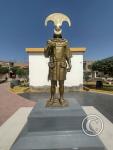 arrived by sea from the south, in the middle of a large fleet of rafts and accompanied by a luxurious court of officials, versed in different arts and trades. He landed at the mouth of the Faquisllanga River (Lambayeque River) and went about 2 km inland, settling in a place where he built a huaca that he called Chot, which is probably the one currently known as Huaca Chotuna. The king brought an idol of green stone ( emerald or jade ) called "Yampallec" (from which the name of Lambayeque is derived), which was a representation of his own image, the same one he kept in the huaca of Chot.
Naylamp inaugurated a long period of peace and prosperity in the region. He had children with his wife and 40 concubines and died at an advanced age. The nobility buried him in his palace, but eager to spread belief in his immortality, they announced that, tired of earthly life, he had used his power to grow wings and soared into heaven. Thus, he was transformed into a divinity. Tumi: representation of Naylamp.
Naylamp inaugurated a dynasty of several sovereigns, twelve in total, including himself; the last of them, King Fempallec, wanted to move the idol Yampallec to another location, provoking the wrath of the gods. During this time, a demon in the form of a woman appeared to Fempallec and tempted him to have sexual relations. The king's sin brought a series of misfortunes to the Lambayeque nation: rain, drought, and famine. The punishment was completed when a powerful tyrant, Chimo Cápac or Chimú Cápac, subsequently arrived from the southern kingdoms and took over the rich lands of Lambayeque.
This legend would explain how a dynasty of successful kings dominated the region based on a religious cult, and that the lack of attention in government by the last of them ultimately ended the dynasty, while the people were conquered by a tyrant from the south. It is known that this tyrant was a Chimú king who conquered Lambayeque. The desperate priests would have sought explanations for their misfortune. That is why the myth ends by suggesting an offense to the gods and the consequent punishment they were able to inflict.
There's a lot more to it, but that gives you an idea of the beginnings, some of it legend, but it ends in the real deal - they were finally conquered by the Chimú king (Chimú Cápac), who made them a province of his kingdom in 1375.
Plaza de Armas
The city has a central plaza, the Plaza de Armas, which I find to be quite nice and very quiet. Unlike other cities, this plaza is not surrounded by retail and hotels. On one side is the Cathedral (mid-17th century in a Renaissance style), another side is Universidad Nacional Pedro Ruiz Gallo (formerly AFUL) in a historic building, and a dress shop.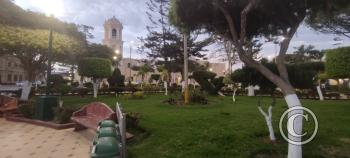 Another side of the school, IE 27 de Deciembre. On the last side is a building that appears to be a school of some type and some other institution. All of these buildings appear to be from the colonial period.
Two blocks from the Plaza de Armas is the Parque Infantil. It's a block-square children's park. It's quite nice. On one side of the park, the road is used as an area for more arcade games, inflatables, and big fun stuff for kids.
My impressions
There is a relatively new residential development on the northeast side of town, apparently former sugarcane farmland, called Alameda Real. That area has many parks and a lot of green space, but very little maintenance is done in the parks. The streets are clean, the infrastructure is all in, and maybe less than half the lots have houses on them. The developer has big plans, but how long will it take to get the development to the point they envision? They say it will include: 30+ parks/playgrounds, sports facilities, and bike paths. Right now, less than a dozen parks, one or two basketball courts, and no bike paths. But, generally speaking, it's a nice area; it just needs some attention from the developer.
In my first visit here, in March 2024, I was walking from the Bruning Museum and somewhere between it and my next bottle of water, I stumbled into a small shop - no name on the front, no GPS location data in the photo, just a handful of antique dresses, some calabash percussion instruments called el checo, and a paper pinned to the wall like a homemade museum label. I snapped some pics, they're in the photo album. And now it’s a breadcrumb I can’t retrace. But that’s how it goes with travel - some finds are meant to stay half-forgotten.
One block from the Plaza de Armas, sits Casa Montjoy, a crumbling colonial relic best known for its enormous wooden balcony, supposedly the longest, 67 meters long, in South America. It wraps around two sides of the house, once elegant, now weather-worn.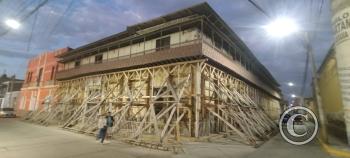 Built sometime in the early 1800s, the house played a small but notable role during Peru’s independence era, serving as a meeting place for revolutionaries. You’d never guess that from looking at it today, but if you squint past the peeling paint and splintering timber, the old grandeur is still there, hanging on, barely.
These days, the entire structure is being held upright by what looks like every beam in Lambayeque. Giant wooden supports lean against its walls from all angles like a crowd trying to keep a drunk friend from toppling over. Restoration efforts have come and gone, mostly gone, and while there’s talk of saving it, the reality is bleak. For now, Casa Montjoy is standing - barely, but it’s more artifact than architecture. And unless someone steps in soon with more than just promises, this piece of history may not be standing much longer. And, there are photos in the photo album.
I like Lambayeque. In fact. It is one of only two towns along the coast that I like enough that I would consider making my new hometown. The other is Ica, in southern Perú (also inland from the coast). Other than along the Pan-American Highway, the city is clean. The streets are not coated with sand, resulting in a dust storm every time a vehicle drives along them, as is the case with pretty much all the other coastal cities. There are parks and plazas throughout the city, and it appears the city takes good care of them. Those stupid moto-taxis are here, unfortunately, but, for whatever reason, they seem to be less annoying, less noisy, than in other cities. And the streets are not clogged with them, whereas in other cities, those stupid machines are simply awful.
The race is down to 4 cities
I now have two cities tied for #1 as my choice of possible new hometown - Moyobamba and Lambayeque. Which will win? I don't know. There's another town in Ecuador I have to spend more time in, then I will be able to decide - Moyobamba (east of the Andes), Lambayeque (northern Perú coast), Puyo, Ecuador (east of the Andes), or Ica (southern Perú coast). The most noticeable difference is, the east side of the Andes is the beginning of the Amazon Basin. The air is clean, the plants are green, and the streets are litter-free. The people greet you in the street as you pass them. The food is tropical and delicious. The coastal cities are drier, not necessarily warmer. There's a bit less humidity. Many people greet you in the streets in passing, but not quite to the level of the Amazon regions. The two coastal cities I like have clean streets and nice parks. The food is more sea-based, but one can find, if you look around hard enough, a restaurant or two serving at least one dish common to La Selva (the jungle, or the Amazon region).
Yes, after now 2 1/2 years of backpacking, visiting close to 300 cities in 8 countries, it's come down to those 4. The real deciding point might be whether I want to be on the east side of the Andes or the west side. I'll make that decision in the next couple of months.

I used to teach English as a foreign language in Barranquilla, Colombia. Now I'm retired and traveling throughout South America.
I'm from Kennewick, Washington, USA. In my previous life, as I call it, I was an IT guy, systems administrator, computer tech, as well as a shipping/receiving guy and also worked as a merchandising guy in a RV/Camping store.