My Books on Amazon






Discover Cajamarca, Peru: History, Tours, and Hidden Gems
July 31, 2025
Cajamarca, Perú, sits at about 2,750 meters (8,900 ft), and so it a bit on the chilly side, and downright cold at night. Night temps drop into the single digits (Celcius). Cajamarca sits in the Andes Mountains and serves as the main commercial and cultural center for north-central Perú. The city has a population of around 250,000. The first settlement was in 1320 by indigenous peoples, and the Spanish, after the conquistadors conquered all the indigenous people, founded the city in 1532. But the real history goes back much further - 200-100BC.
The Cajamarca culture is also known for its own distinctive ceramic pottery that dates back to 200-100 BC. Throughout the history that part of the culture persisted through all the changes of leadership and through the Spanish conquistor years, and up to today.
Colonial Architecture
Something that is noticable right away - Cajamarca has its own style of architecture construction - stone, not the more common adobe/clay blocks. It is evident throughout the city. There are hundreds, if not thousands, of buildings dating back to those colonial days (see the photos in my photo album). And there are six 17th-century churches still being used, three of which are quite impressive, photos in the photo album, as well. After the Spanish conquered the Incas they destroyed just about everything the Incas had built, and rebuilt the city in their own ways.
In 1986 the Organization of American States designated Cajamarca as a site of Historical and Cultural Heritage of the Americas. It is clear why - the architecture and culture, the people still following many of the old ways. Here's something I noticed right away when arriving - unlike Chachapoyas which I visited the last few days, Cajamarca does have the awful 3-wheel motorcycles clogging up the city streets, honking there beep-beep horns, and just being generally annoying.
The City Center
The city center is a nice place to visit, with all of the very old architecture, lots of coffee shops, gift shops everywhere, and shops of "artesanales" - hand-made items such as purses/bags, clothing of all types, hats, and so on, and are made by local indigenous people. This small city is not particularly loaded with park space, there are neighborhood parks, but nothing really stands out except for Mirador Bellavista. Mirador translates to viewpoint. It's a nice park on a hill at the edge of the city and provides a view of the entire valley. There is an entry fee, but it's only 3 soles (if I remember correctly), which is less than one US dollar.
For History Buffs
For those of you who love history, there are many archeological sites in the mountains around Cajamarca, and there are a bazillion tour agencies in the city. The most popular areas to tour are: Namora, Cumbemayo, Granja Porcon, Ventanillas de Otuzco, Hacienda la Colpa, Kunturwasi, Polloc, Lagunas de Alto Perú, Parqué de Estatuas Gigantes, El Castillo de Yanamarca, and of course various city tours. In about 2 1/2 years of backpacking through South America, I've only joined three group tours - the first was a flight over the Nazca Lines, which is well worth the cost which is significantly less than Machu Picchu. The other two group tours I did were here in Cajamarca.
Archeological site - Cumbemayo
I went to Cumbemayo, a valley region outside of Cajamarca where ancient peoples carved petroglyphs, canals, a sacrificial flat-topped boulder, and more.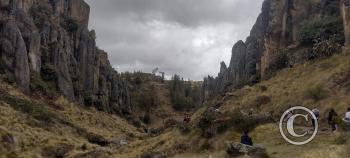 These features date back to roughly 1500–1000 BC, long before the Chachapoyas emerged. Archaeologists believe Cumbemayo served mainly as a ceremonial and engineering site rather than a settlement—the Chachapoyas themselves, who appeared around 200 BC–800 AD, lived in villages in the Cajamarca highlands a few kilometers east. Between 1460 and 1470, the Chachapoyas were conquered under the Inca emperors Pachacuti or, according to some accounts, Túpac Inca Yupanqui. Even then, they never fully submitted and rebelled repeatedly against Inca rule. (See the photo album for images from the site.)
Archeological site - Ventanillas de Otuzco
My other group tour was an area called Ventanillas de Otuzco. This is located just 8 kilometers from Cajamarca in the area called "Baños del Inca." The Ventanillas are a Pre-Inca necropolis (burial site). It dates back to about 500 BC to 500 AD and is typically linked to the Cajamarca culture. What these ventanillas, or 'little windows' are is carved niches in the volcanic rock cliffs. They were used as tombs. By the time the Incas arrived, it was already an ancient site, and they may have repurposed or respected it as sacred. (See the photo album for images from the site.) The tombs have all been robbed of everything and anything that was in them millenia ago, so now they are completely empty.
As for the guided tour - I recommend you skip the guided tour for this particular site. Why? Because half-an-hour at the site is not enough time. The rest of the time for the tour is spent at a farm where you'll see a corral and some cows, and another corral and some horses. Then, you'll go into a gift shop. Then the tour goes to an group of artesanal shops and a garden. Then you'll finally arrive at the site of the tombs. After a half-hour, you'll go up the road a few blocks and visit a suspension foot-bridge over the river. Again, you can't walk around and explore the area as it is private property, so you take a picture of the bridge and return to the van. My recommendation: hire a taxi and go straight to the Ventanillas.
For Museum Lovers
I had also bought a ticket that provided entrance into several museums, one of which I could have skipped (it was part of a convent, so it was a museum of religious stuff). But, it did include entrance to the Cuarto del Rescate (Ransom Room). This room measured about 6.7 meters by 5.2 meters (22 ft x 17 ft). That tour was interesting - The most famous leader of the Incas, Atahualpa, was imprisoned in this very room. In 1532, the Spaniard Francisco Pizarro was told where he could find Atahualpa, the leader of the Incas - in a place now called Baños del Inca, just outside of Cajamarca. Pizarro made arrangements to meet with Atahualpa, and kept only 168 soldiers with him, while he had, according to reports, 40,000-80,000 soldiers waiting out of sight. They met at the Cajamarca plaza, then the thousands of soldiers descended on the entourage of Atahualpa, only several thousand strong, wiping them out in quick fashion, as they came to the meeting unarmed. Pizarro offered to return Atahualpa in exchange for ransom, and the people brought gold and silver and filled a room with it. He was imprisoned until 1533, when Pizarro put him on trial, with Pizarro acting as Judge, and sentenced him to death. Atahualpa turned to Pizarro and exclaimed (according to reports), "What have I done, or my children, that I should meet such a fate? And from your hands, too, you, who have met with friendship and kindness from my people, with whom I have shared my treasures, who have received nothing but benefits from my hands!" Two hours later, Atahualpa was burned at the stake. The Inca Empire was finished. (See the photo album for images from the site.)
Here is a short timeline to sum it all up:
- 1500–1000 BC: Cumbemayo – ancient canals, petroglyphs, and a sacrificial stone. No houses—this was ceremony central, not suburbia.
- 500 BC–500 AD: Cajamarca culture – the folks who carved the Ventanillas de Otuzco “little window” tombs into solid rock.
- 200 BC–800 AD: Chachapoya culture – the “Cloud Warriors.” Tough, mountain-dwelling people who later gave the Incas a headache.
- 1460–1470 AD: Inca takeover – Pachacuti or Túpac Inca Yupanqui conquered the region. Chachapoyas didn’t exactly roll out the welcome mat; they rebelled. A lot.
- 1532 AD: Enter Pizarro – the Spanish stroll in, trap Atahualpa in Cajamarca, and demand a room full of gold.
- 1533 AD: Atahualpa executed – so much for negotiations. The Inca Empire collapses.
- 1532–1535 AD: Spanish remodel – out go the Inca buildings, in come the stone churches that still dominate the city.
- 1986 AD: Cajamarca earns its title – declared a Historical and Cultural Heritage site of the Americas. And yes, it deserves it.

I used to teach English as a foreign language in Barranquilla, Colombia. Now I'm retired and traveling throughout South America.
I'm from Kennewick, Washington, USA. In my previous life, as I call it, I was an IT guy, systems administrator, computer tech, as well as a shipping/receiving guy and also worked as a merchandising guy in a RV/Camping store.