My Books on Amazon






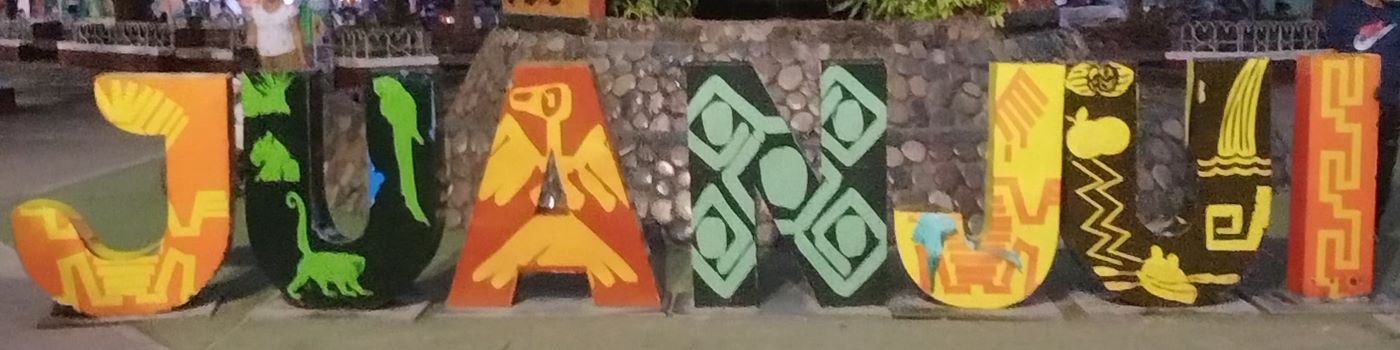
Juanjuí, Perú
July 12, 2025
Juanjuí, Perú is the capital of the Mariscal Cáceres Province in the heart of San Martín. It is home to about 55,000 people. The Huallaga River runs right alongside town, carving a wide valley between the Cordillera Central and the Cordillera Azul. Along the river, there is one 2-block-long area of park space and restaurants, referred to as their tourist area.
Before the Spanish arrived, the area was marked by conflict, with many rival native groups fighting for control of the land. When the Spanish missionaries arrived, they forcibly organized these diverse ethnic groups into "reducciones" (missions) and relocated them into unfamiliar territory. It's a familiar story, one that mirrors the experiences of Indigenous communities in North America. Those who resisted were labeled "infidels." Juanjuí was officially recognized as a district in 1866, elevated to villa in 1906, and was finally given city status in 1927. That promotion didn't sit well with Sapasoa, the former provincial capital. The rivalry turned heated, with both towns fighting over political control. Eventually, in 1940, the national government settled the dispute by creating a new province, naming Juanjuí as its capital.
The town's economy grew on agriculture, rubber, and barbasco, with the Huallaga River providing a vital trade route to Iquitos and Brazil. In the 1960s, cotton arrived and pushed Juanjuí into a new phase of agro-industrial development. Then, in 1972, a devastating earthquake damaged about 80% of the homes. But Juanjuí rebuilt. In 2011, the province was honored as the country's leading producer of organic cocoa, both nationally and internationally. This recognition gave the local economy a boost and placed Juanjuí among the top cities in the region in terms of economic growth.
The town itself is pleasant, with a well-kept Plaza de Armas, river access, and visible improvements to protect against flooding. The Huallaga is big and unpredictable here; it's fast-moving, brown, and alive. It gives Juanjuí both its opportunities and its challenges.
I didn't have time to visit the nearby tourist spots, but there are plenty: the Catarata del Breo waterfall in the nearby district of Huicungo is worth a look, and farther out you'll find the ruins of Gran Pajatén and the biodiverse forests of the Río Abiseo National Park. If you're into nature, waterfalls, or ancient ruins, Juanjuí makes a good base to start exploring.
There's also solid infrastructure here: schools, a technical college, hospitals, and regional health centers. Markets are active and full of fresh produce, cocoa products, and local food. This isn't a flashy tourist town; it's real, it's working, and it's grown a lot in recent decades.
If Moyobamba or Tarapoto feel too busy or too modern, Juanjuí offers something a little different. It's quieter, humbler, and more connected to the river, the land, and its past. Whether you're a traveler looking to experience a different side of the Selva, or just passing through en route to somewhere else, Juanjuí is worth more than a glance. For me, though, Juanjuí is too dusty and too noisy to consider for my new hometown.

I used to teach English as a foreign language in Barranquilla, Colombia. Now I'm retired and traveling throughout South America.
I'm from Kennewick, Washington, USA. In my previous life, as I call it, I was an IT guy, systems administrator, computer tech, as well as a shipping/receiving guy and also worked as a merchandising guy in a RV/Camping store.