My Books on Amazon






Pozuzo and Codo del Pozuzo, Perú
July 7, 2025
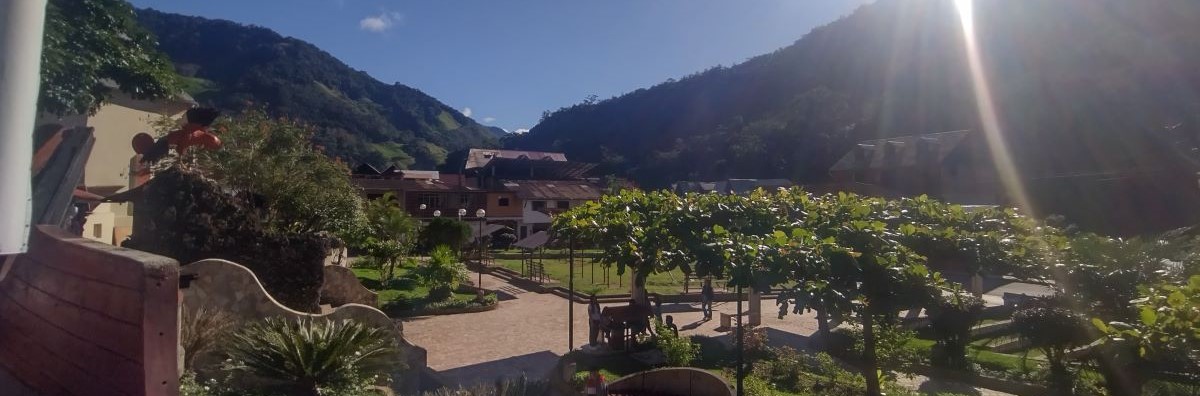
Pozuzo and Codo del Pozuzo are both located on the eastern side of the Andes Mountains in central Per?. After my visit to Huancabamba I went to Pozuzo. Pozuzo is a very nice town, apparently more on the high-middle class level, as was Huancabamba. But, the big difference here is the people - they do not say 'buenos dias' or 'buenas tardes' etc. When I say those the few that respond give little more than a mumble. The town itself is pretty, the plaza, the valley around. I like it here, it's just the people - they are not as friendly as the previous couple of towns.
The town sits at 739 meters above sea level and is home to just over 1,300 residents. It?s a very small place, for sure, but its story is anything but. Read on for some history.
In 1857 group was 180 Tyroleans + 120 Rhinelanders, followed by a second wave from Tirol and Bavaria in 1868. Pozuzo was founded in 1859. It is the oldest and only officially recognized Austro-German colony in Per?. These settlers journeyed across the Atlantic on the ship Norton, made their way up the Amazon River, and then crossed the Andes Mountains on foot - many dying before ever reaching their promised land. Those who survived built Pozuzo from the ground up. For over a century the town remained isolated, accessible only by mule trails until a rough road finally connected it to the rest of the world in 1975.
Today, Pozuzo blends its heritage with jungle reality. Its streets feature wooden chalets with steep gabled roofs and flower boxes under the windows, but instead of misty European forests, they're framed by banana trees and the sound of tropical birds. The central plaza is neatly kept, complete with a scaled-down replica of the Norton as a monument to those early settlers. It's not just a nod to history - it's a statement of pride.
Walking around town, you'll find bakeries serving German-style breads occasionally, restaurants supposedly offering schnitzel and sausage (I didn't come across any), and very-occasional signs written in German script. But this is no theme park. Pozuzo feels lived-in and grounded, with locals going about daily life in a mix of Peruvian and European rhythms. While only a small percentage of the current population has German ancestry, the traditions linger, especially during festivals like Pozuzofest in July, when folk dancing, polka music, and lederhosen fill the streets.
The valley is just as interesting as the culture. Pozuzo sits along the Huancabamba River in a green valley surrounded by sharp hills and cloud forest. The town is a gateway to the Yanachaga-Chemill?n Biosphere Reserve, and just outside town is the Puente Emperador Guillermo I, a hanging bridge originally built in the late 1800s. It spans the river with rustic charm and makes for a scenic, if slightly wobbly, walk.
Pozuzo's cuisine is its own blend of cultures. You might find dishes like goulash and sp?tzle served alongside jungle staples like yucca and plantains, though I didn't see any mention of any German foods on menus. Many restaurants double as family homes, and the food is usually made from scratch, sausages cured locally, cakes baked that morning, but then, this is common for bakerys throughout South America. It's the kind of place where the butter's real, the beer might be homemade, and dessert almost always means strudel.
Despite its idyllic look, Pozuzo isn't overly touristic. It has its share of visitors, but it hasn't sold out its character for the sake of foot traffic. What it offers instead is something quieter and more sincere: a unique cultural story rooted in survival and adaptation, set against a backdrop of natural beauty.
Visiting Pozuzo feels like slipping into a forgotten chapter of both European and South American history. It's not the friendliest town in the region - the warm greetings you might have received in Huancabamba or Oxapampa may not come as freely here - but the people are courteous, the town is clean, and the surroundings are hard to beat.
If you're heading through the central jungle, Pozuzo is worth stopping at. Come for the oddity, stay for the peaceful charm, and leave knowing you've seen a corner of Peru unlike any other.
There are lots of hotels, hostals, etc and lots of restaurants here, the plaza is nice, there is one, 1, ATM. And when I was here it was out of service. The next closest ATM is several hours by car, so bring cash with you.
Codo del Pozuzo
Codo del Pozuzo sits where the Pozuzo River bends sharply - hence the name. This small town is the capital of its own district within Hu?nuco's Puerto Inca Province. Despite its quiet appearance, it's rapidly emerging as a regional example of ecological value and rural pride. Though why, I don't know. I saw nothing particularly interesting or of any ecological value. That stuff must be well outside of town.
Founded in 1967 by pioneers branching out from Pozuzo in search of fertile land, the settlement began when L?zaro and Eliseo Florida Schmidt led the first ascent to discover the sweeping plain beyond dense forest. By 1984, Codo del Pozuzo had risen from a small caser?o to full district status.
Though small, the town is not isolated. It serves as the administrative and economic hub for about 6,000 people, the area consists of gently rolling plains and steep ravines between 500 and 1,500?m altitude. Unlike Pozuzo, which leans heavily on Austro-German heritage, Codo is a mix of mestizo settlers, cashivo communities, Andean colonists, and indigenous Y?nesha/Ash?ninka groups.
The town's main plaza is certainly large enough - 2 blocks square - while most small town's have plazas of 1-block square. The plaza is nice, but when I was there I saw few people in it, the most at one time I saw was half a dozen. The town has sufficient hostals and restaurants, but no ATM. NO ATM. That's important to know because the closest ATM is several hours by car. So bring cash, not only for Codo but the next several towns you will pass through on your way north to Tarapoto or south to Oxapampa.
The town has the main "highway" and one other road that have almost all commercial businesses, other than that, the rest of the roads are residential or farm and all dirt.
So, if you want to see Oxampamp, and that is a place to see, you will be taking Route 5N, the west fork. That puts you in the Huancabamba River valley up to Pozuzo, then from there to Codo del Pozuzo you will be in the Pozuzo River valley. The road is in good condition up to Pozuzo, from there northward it becomes a quite rough mostly broken pavement or dirt road. The Huancabamba River begins where several highland streams converge near Oxapampa, flowing northward through a deep, narrow canyon with surrounding mountains rising over 3,000?meters. For about 77?km, the road runs alongside it, a true mountain-to-jungle corridor. North of Pozuzo town, where the Huancabamba meets the Santa Cruz River, it becomes officially known as the Pozuzo River. That's where the road deteriates. I swear, Mother Nature is doing everything she can do stop people from cruising through her valley. Landslides are common and visible throughout the trip, there are a few places where the river or waterfalls have eroded the road down to rubble. But humans keep clearing away the debris and cruising the valley. I'm sure Mother Nature is not happy about that.

I used to teach English as a foreign language in Barranquilla, Colombia. Now I'm retired and traveling throughout South America.
I'm from Kennewick, Washington, USA. In my previous life, as I call it, I was an IT guy, systems administrator, computer tech, as well as a shipping/receiving guy and also worked as a merchandising guy in a RV/Camping store.