My Books on Amazon






Villa Rica, Perú
July 2, 2025
Almost hidden off the main highway, on the eastern slopes of the Andes, Villa Rica sits at1,460 meters above sea level in the Oxapampa Province of the Pasco department in central Perú. ItsWikipedia entry outlines the essentials - founding in 1925 by German immigrants, it gained its status for its coffee,and 2017's 18,763 population - it doesn't capture the texture of daily life, cultural collisions, or why this placestays in your mind long after you've left.
We know the Franciscan mission at Cerro de la Sal began in 1635 and faced rebellion under JuanSantos Atahualpa in the 1740s, it's less known how local Yánesha communities bypassed Spanish control for morethan a century afterward.
The 1925 founding by Leopoldo Krause and colleagues began as "Colonización Rada y Gamio," but by 1944 Villa Rica officially became part of Pasco and Oxapampa Province under Law No. 10030.
By the 1980s, this former frontier grew into a regional hub, as export-quality coffee brought inmigrants from the Andes and beyond, transforming it into a multicultural patchwork of Yánesha, German-descendant colonos, and more recent settlers.
The people of La Selva region of Perú; are, in my opinion, the friendliest in South America (and I've visited eight countries and over 300 towns and a few cities in SA). When I decide to hang up my backpack and settle somewhere, it will be here in La Selva. I just haven't picked which town, yet.
Villa Rica is not just a coffee hub - it's officially the "Tierra del Café más Finodel Mundo", granted Denominación de Origen in 2010 by Indecopi. Local farms between 1,200 and 1,800 meters altitude benefit from volcanic soils and lush micro-climates inside the Yanachaga-Chemillén Biosphere Reserve, giving beans with floral aromas and balanced sweetness.
All throughout the town, you will find coffee shops that provide the best coffees - Geisha and Bourbon - grown locally. I did find one with the slightly lower-level Catuaí, but it was still a very good coffee, and the lady who owns and runs the shop speaks some English. She also sells packages of coffee and some gift items.
Some of the interesting places to visit near Villa Rica include: Cerro de la Sal: Just 7km away, once the salt source for Asháninka and Yánesha communities trading across the Amazon Basin.
Laguna El Oconal: A peaceful mountain lagoon ringed by lily pads and orchids, still used by Yánesha ancestral visitors. I visited the lake and next to it the coffee farm and tourist place - Finca la Torre. Finca translates to 'farm,' and torre translates to 'tower'. On the coffee farm they do a short presentation, in Spanish, to the varieties of coffee and the proper ways to brew coffee. They also have a store where they sell coffee they have grown on that farm, and of course gifts. The tower, which is something like three-stories tall, was still in construction when I visited it. The lake is very pretty, lilly pads, flowers, boatsthat get rented sometime, they weren't being used when I was there, and a boardwalk thing you can sit on and dangle your feet in the water for some kind of therapy. Many tour groups visit both the coffee farm and the lake so there is always transportation to and from, but I walked, it was only a half-hour walk each way from my hostal.
Waterfalls El León & El Encanto: Lush, accessible by short hikes, and still unspoiled inmany low-visitor zones. During my few days here I didn't visit the falls.
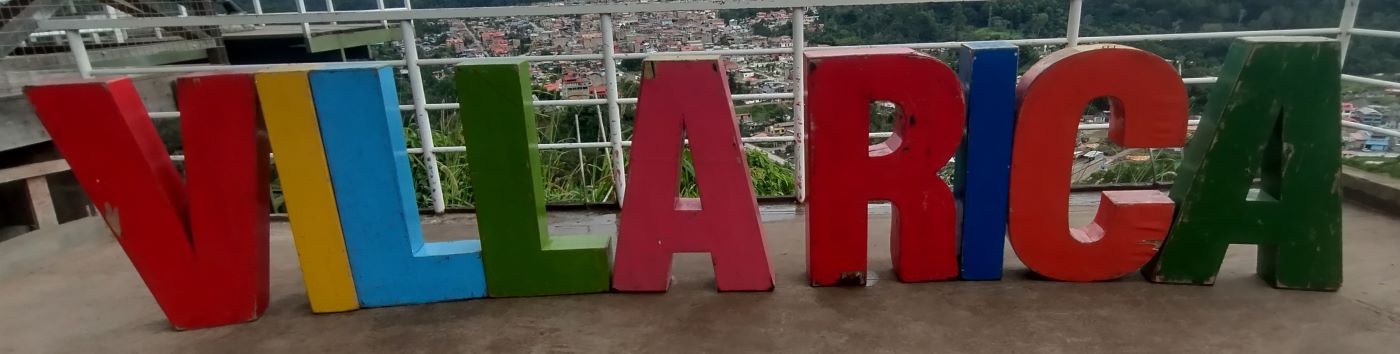
El Parque del Café, Westreicher, opened 2010, where locals and tourists can experience tastings, workshops, and giant "Villa Rica" photo ops among greenery. <- that is what the websites say about it. Inreality - the park is now a large green area of uncut grass and very small trees. There are not sidewalks/walking pathsin the park, it's just a pleasant large green area. There are a few benches, and when I was there a couple of mothers with their children and one young woman sitting by herself on a bench.
Malecón Entaz, the riverside promenade along the Río Entaz - once a tragic flood zone, now a community venue with birdwatching, evening strolls, and festivals on the banks. <- That's what the websites say, but in reality, it's a gravel path starting to grow grass and the grass areas are uncut. Obviously, this "malecón" has seen little to no maintanance over the years.
Both of the above - the park and the malecón, are peaceful and green, but don't expect manicured paths or polished attractions - sit and listen to the birds, or watch the river flow by, or bring a book and enjoy the peace away from the main street.
Panteón de los Colonos, with a 10-meter cross honoring early German colonists and Yánesha ancestors, it's the country's third-oldest Austro-German cemetery and a potent symbol of integration.<- And again, there are websites that say this is in Villa Rica, well, they're wrong. It's in Huancabamba, more than 60 kilometers north of Villa Rica.
So, should you visit Villa Rica? It is out-of-the way, but yes, it is worth a visit, even a night or two. I like this town, its bigger than I expected, so has decent shopping options. And there are enough attractions in the area to keep you busy for a few days.

I used to teach English as a foreign language in Barranquilla, Colombia. Now I'm retired and traveling throughout South America.
I'm from Kennewick, Washington, USA. In my previous life, as I call it, I was an IT guy, systems administrator, computer tech, as well as a shipping/receiving guy and also worked as a merchandising guy in a RV/Camping store.