My Books on Amazon






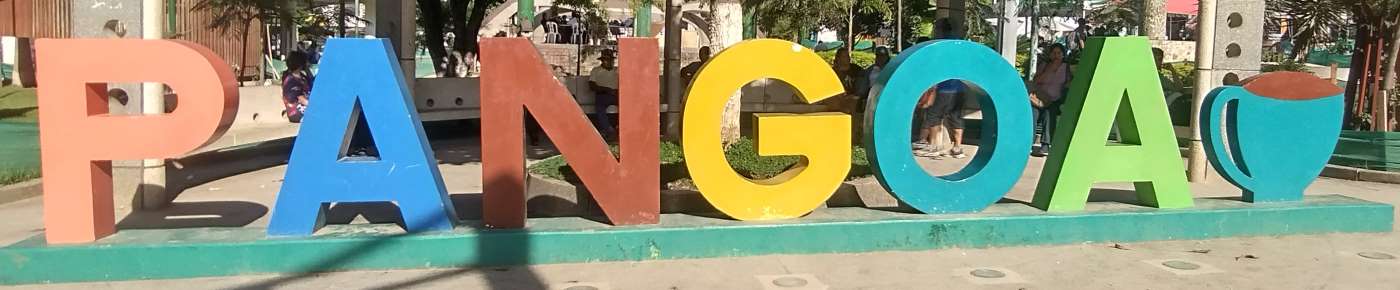
San Martín de Pangoa, Perú
June 28, 2025
I'm in San Martín de Pangoa, Perú. This is a town in "La Selva Central" region - the central part of Perú on the Amazon side of the Andes Mtns. I hiked from Mazamari to Pangoa, it took 3 hours and 22 minutes, hotel to hotel. That was with my backpack of about 17 kilos (37 pounds), and two stops for snacks and drinks. My backpack isn't so heavy because I am not carrying camping gear, I stay in hotels/hostels/residencias/hospedajes. In South America those are all basically the same, the only real difference is in the cost per night. Residendencias and hospedajes are the least expensive, and most basic. But today I got a room for 30 Soles (less than US$10) per night and it has a queen-size bed, nightstand, desk/chair, 40" TV. I've had hotel rooms with less for more money. This place is called Hostal El Encanto de la Selva, it's one black from the main plaza.
This town is bigger than Mazamari, it's neighbor about 15 kilometers north, but right now, it's notexactly a fun place to visit. Why? Because every street within two blocks of the town plaza is in construction for newconcrete pavement, new sidewalks, and infrastructure. It's a mess. Some of the streets look like they were mine fieldswhere all the mines blew-up at the same time.
San Martín de Pangoa was originally founded as a mission settlement around 1673 in what isnow Sonomoro, as part of Franciscan missionary efforts. Sonomoro is an indigenous community about 7 kilometers east ofPango. The Proclamation of Pangoa as a district came on March 26, 1965 shortly after creation of Satipo Province.
The town's name derives from the Asháninca word pangá, referring to a localriver - and another interpretation links it to pangotsi, meaning "house," symbolizing the welcoming nature oflocal indigenous communities. I will add, the people here are quite friendly. The same in Mazamari.
In the 1980s, San Martín de Pangoa was caught up in the turmoil of the Shining Pathinsurgency. The road to town became infamously known as "el camino donde la vida no vale nada" ("the road where life isworth nothing") due to paramilitary patrols and violence.
As violence subsided, residents returned. However, without market infrastructure, many turned tococa farming until the emergence of legal alternatives.
In 1977, fifty local coffee farmers broke away from a larger Satipo co-op to establish theCooperativa Agraria Cafetalera Pangoa. The new co-op grew to nearly 1,700 members by the early 1980s and reinvested 3%of sales into building their infrastructure, much of which remains in use. Satipo is a larger town about 35 kilometersnorth of Pangoa.
Under the leadership of women like Esperanza Dionisio Castillo and the CODEMU women's committee(established in 2001, CODEMU is the Spanish acronym for “Comité de Desarrollo de la Mujer” -literally, the Women's Development Committee of CAC Pangoa. It's a dedicated committee within the Cooperativa AgrariaCafetalera Pangoa (CAC/Cooperativa Agraria Cafetalera Pangoa), aimed at promoting women's leadership, empowerment, andeconomic participation in the cooperative), CAC Pangoa reached fair-trade certification in 2001 and organiccertification in 2002. They also diversified into native cacao farming. Cacao is where we get cocoa and then chocolate.There are orchards of cacao trees everywhere here. I love the scent of the drying cacao seeds in the streets. It ismore common in Mazamari than here in Pangoa, at least in the parts of Pangoa I have seen.
Programs include microcredit, forest conservation incentives, education support, and women'sempowerment through leadership training.
The town and its surroundings are home to the Nomatsigenga people, whose language is widely spokenin the district with about 3,900 native speakers and recognized with an official alphabet by the Peruvian Ministry ofEducation since 2015.
In Pangoa, these women often walk into town from nearby native communities to sell or buy goods, attend meetings, orcollect payments from programs like those tied to CAC Pangoa or education and health services.
More about the Nomatsigenga indigenous people: the women are known for wearing simple, long,one-color dresses, especially in towns like Pangoa, Sonomoro, and other parts of Satipo Province. These dresses areoften loose-fitting and modest, typically made from lightweight cotton or synthetic fabric, and may be in bright orsolid colors like purple, blue, green, or red.
The Nomatsigenga are closely related to the Asháninka people (and sometimes mistaken for them), but theymaintain their own distinct language, traditions, and dress. Clothing for women tends to be practical, reflecting alifestyle rooted in agriculture, tradition, and community values.
Even though Mazamari and Pangoa are only about 15 km apart, they represent very different cultural and administrativespheres, and that small stretch of road crosses a kind of invisible boundary:
- Pangoa is the district capital for a vast rural zone that includes dozens of Nomatsigenga and Asháninkacommunities. Many of them send representatives to town for services, trade, or cooperative involvement (like CACPangoa).
- Mazamari, by contrast, has more of a mestizo, military, and settler feel. It’s cleaner, more organized, andhas less visible indigenous presence because:
- It’s closer to the VRAEM military base (Valle de los Ríos Apurímac, Ene y Mantaro), so it has amore formal, state-aligned culture.
- It historically served as a staging point for counterinsurgency and coca eradication programs, and was developedmore for logistics than for inclusion.
- Indigenous people there might feel less welcome or less connected to the town's institutions or economy.
In Pangoa, it’s common to see Nomatsigenga women walking into town from surrounding nativecommunities. In Mazamari, most native communities are farther out, across rougher terrain or outside direct transportroutes—so there's less foot traffic from them.
Also, Pangoa has more outreach programs tied to native rights, health clinics, and co-ops like CODEMU, which directlydraw in indigenous women. In Mazamari, those programs are more likely focused on logistics, law enforcement, or generalagriculture.
Villages like San Antonio de Sonomoro celebrate rich ethnic festivals featuring traditional dance,canoe races, arrow-fishing, masato tasting, communal painting, and the crowning of a nomatsigenga beauty queen. Theseevents engage neighboring communities including Yaneshas and Asháninkas.
Oh, today when I was out walking through the plaza, I came across "helado frito". I asked for HeladoLucuma (I like the lucuma flavor), and the girl put a little bit of the ice cream on an icy frosted flat panel, alittle milk, then mixed them with two flat spatulas, basically wide putty knives. Then she spread it out over the frostmetal panel, very thin, it froze, then she scraped it up into rolls the width of the putty knife, placed the rolls intoa cup, and squirted a bit of strawberry juice over the top. It was delicious, I've seen that before, anywhere.
I asked ChatGPT for information about that helado and this was it's response: The technique yousaw comes from Thai-style rolled ice cream, but seeing it in a small Peruvian town, using local fruit, gives it acompletely different flair. And lucuma? Creamy, nutty, caramel-banana-pumpkin hybrid—Peru’s gift to thedessert world. Add a splash of strawberry juice? You basically got a jungle sundae with a street-food soul.
So, should you visit Pangoa? Only if you're traveling on this side of the mountains. I wouldn't sayit's worth going out of your way, unless you want to try the helado frito. That might make it worth the side trip.

I used to teach English as a foreign language in Barranquilla, Colombia. Now I'm retired and traveling throughout South America.
I'm from Kennewick, Washington, USA. In my previous life, as I call it, I was an IT guy, systems administrator, computer tech, as well as a shipping/receiving guy and also worked as a merchandising guy in a RV/Camping store.