My Books on Amazon






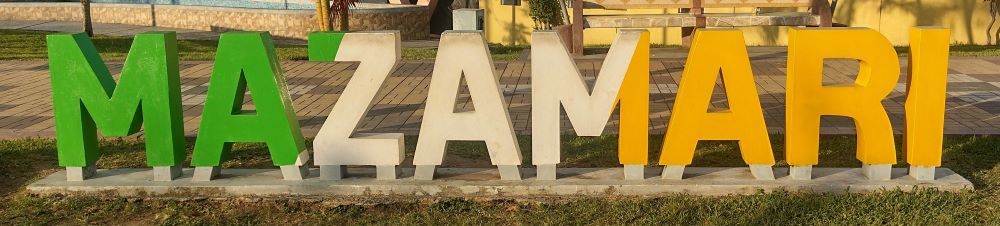
Mazamari, Perú
June 25, 2025
I'm in Mazamari, Perú, again. My first visit here was in February, 2023; my second visit wasJuly, 2023; and my third visit was in April 2024. I like this little nothing-special town. It's so little it has nosupermarket and a few ATMs. The town has three official parks and one green area alongside the river, which runsthrough the edge of town, which is only about five or six blocks from the town center.
This past weekend, Mazamari, Perú celebrated its 60th anniversary with four full days ofmusic, dancing, street parades, and beer-fueled tradition. I arrived one day late, but still caught plenty of theaction - horn bands blasting through the streets, dancers in colorful costumes, and entire neighborhoods sharing beerswhenever the unmistakable call of Chonguinada or Tunantada rang out. According to one young woman I spoke with, thosemusic styles are basically "beer songs". The bands will parade around town, one by one, through the neighborhoods, andstop to play in front of some houses. The people in the houses are supposed to come out and share beers with the bands.They continue all throughout the town. The weekend was loud, chaotic, and unforgettable. And quite interesting, to saythe least.
But beneath all the noise and color lies a surprisingly rich, and relatively short history.
Long before Mazamari became a town, this part of Perú's central jungle was home to Indigenousgroups like the Asháninka, Campas, Shoras, and Cashivos. Traces of their cultures remain, from oral traditionsto petroglyphs hidden in nearby river valleys. These were people of the forest - hunters, gatherers, and rivernavigators, whose knowledge of the jungle still shapes local life.
By the late 1800s, Franciscan missionaries pushed into the region, building missions and bringing inAndean settlers who started cultivating coca and rubber. Resistance was fierce at first - Indigenous communitiesbriefly expelled the newcomers between 1873 and 1885, but the tide eventually shifted.
In the early 1900s, the jungle's promise drew in European immigrants from Austria, Hungary, andGermany. They settled along the Pauriali River, forming a short-lived outpost called Villa Flavia. The jungle provedtoo harsh for many, and the original settlement faded, but its roots remained. Some settlers stuck around andeventually moved closer to the airstrip that would become the heart of modern Mazamari.
It wasn't until October 7, 1952 that the village of San Juan de Villa Flavia was officially founded,complete with a small chapel and school. Just a few years later, in 1956, the Manuel Prado airstrip was completed,linking the region to the rest of Perú by air and kicking off Mazamari's growth.
Urban planning began in earnest by 1959, and by March 26, 1965, the Peruvian government officiallyrecognized Mazamari as a district. That's the anniversary that locals, and a few lucky backpackers (like me),celebrated this past weekend. It marked the town's rise from a rough frontier camp to an organized district withdefined borders, local leadership, and growing economic potential.
One major moment in Mazamari's post-1965 story: the creation of Los Sinchis, a tactical junglepolice unit stationed here. Founded during the same decade, the Sinchis brought national attention to Mazamari, and apermanent military-police presence. For better or worse, their base is now a fixed part of the town's identity.
Today, Mazamari is a town of about 28,000 residents and serves as a key link between the Andeanhighlands and Perú's Amazon basin. It's often called the "golden gateway" to the central jungle, with itseconomy driven by coffee, cacao, pineapple, citrus, ginger, and increasingly, tourism.
The airfield is still active (primarily for parachute training and police planes), now called theMayor Nancy Flores Páucar Airport, and the town is growing in both population and importance. But it hasn'tforgotten its roots. The Asháninka community still plays a role in the region's culture and identity, andtraditional music and dance from neighboring Huancayo regularly echoes through the streets during major events.
The festival I saw wasn't just a celebration, it was a declaration that even a townborn in the jungle less than a lifetime ago can forge a vibrant, complex identity. With every horn blast and beertoast, Mazamari reminds visitors that it may be young, but it's carved out its place with pride, resilience, andrhythm.
I've written about Mazamari previously, this was my 4th time visiting. This town is indeed quite small, but I like it, even if it doesn't have a supermarket or any store even close to one. The town does have those stupid 3-wheel moto-carros, typically used as taxis. There's no in-town bus service, it's not needed, a person can walk from end-to-end in half-an-hour. There's decent bus service to other cities, though. But, what is it about Mazamari that I like? It's peaceful, it's a pleasant place to be, to walk, to visit with other people, to smell the scent of cacao drying in the streets. The people here are happy, always in a good mood, open to talking to anyone who happens by. There's a horn-band playing somewhere in the neighborhood, probably a few blocks away, not the kind of thing you'll hear in North America. It's a very nice change of pace. And, based on my several visits to this region of Perú, this applies to all of this region, known as "La Selva" - the jungle. When I finally decide to stop backpacking and settle down someplace, it will be in La Selva de Perú.

I used to teach English as a foreign language in Barranquilla, Colombia. Now I'm retired and traveling throughout South America.
I'm from Kennewick, Washington, USA. In my previous life, as I call it, I was an IT guy, systems administrator, computer tech, as well as a shipping/receiving guy and also worked as a merchandising guy in a RV/Camping store.