My Books on Amazon






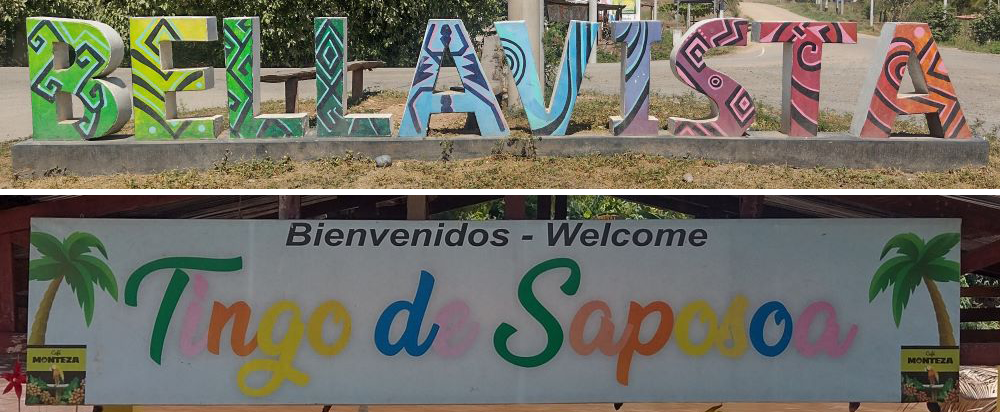
Bellavista and Tingo de Saposoa, Perú
August 16, 2023
Bellavista (pop. about 20,000) and Tingo de Saposoa (pop. about 800), Perú, are two towns in the northcentral-east part of Perú. They are alongside the Huallaga River with the Amazon region starting on across the low mountains on the east side. This valley is between the larger Eastern Range and the smaller Sub-Andean Belt. East of that is the Amazon Basin.
I'm writing about both towns in one blog because Saposoa is so small I walked almost every street in town in less than two hours. After that, I went on to Bellavista where I stayed for two nights. I left Juan Juí in the morning and hiked to those two towns, a total of close to 25 kilometers, not counting the extra exploring. In my photo album the two towns are in seperate albums, and the album for Saposoa includes pics of the route between it and Juan Juí.
Saposoa, as mentioned, is very small. It has a couple of schools and some home-based businesses, and that's it. It's basically a residential community between the river and the highway. Bellavista is a town with a proper central business district built around the central plaza. There are a few banks and cash machines, but no supermarket. Otherwise, you'll find everything needed in the many other small businesses and the mercado. The town is built on four levels - the central area (the main 'old' town) is along the river, then there's the area with the airport, sitting on the second level. The third level has the highway and the newer businesses that popped up when it was built. And, somewhere beyond that is a fourth level. I walked the first three levels but did not see the fourth level. But, I was told it's there.
Tocache has a tropical climate. The average daytime high of 29° C (84° F), and the nightly average low of 22° C (72° F). The city's elevation averages 287 meters (942 feet). The average yearly rainfall amounts to 2311 mm (91 inches) of rain.
So, my impressions: From the lower town (at river level) up to the third level (where the highway is) is quite a hike if you happen to do what I did - take one of the side roads that goes straight up the front of the ridge. Don't do that. Those roads are gravel, steep, and not safe, especially if you happen to have a heavy backpack strapped to your back, not that anything happened to me on the climb up, but if I had tripped I would have rolled all the way down to the bottom. But, the roads that wind up to the top via switch backs are few - only two. The upper part of town along the highway is nothing special other than two parks, both of which are nicely kept, one has quite a few topiary trees. There are a few hotels up there, but really, just stay in the main first level part of the city, next to the river, it's much nicer. The streets are clean, there's almost no horn-honking, and the people, as are all Peruanos, very friendly. When I was out walking nearly every person I passed said 'good morning' or 'good afternoon' to me (in Spanish, of course). Another man I passed invited me to sit and talk with him. We chatted for close to an hour. In the US, a couple of generally taboo topics for people to talk about are politics and religion, but not here. Every time I have the opportunity to spend time chatting with anyone, eventually they ask me about my religeous viewpoints. This has happened many times throughout my journey of South America. Anyway, Bellavista is Spanish for 'beautiful view' and it is fitting for the town with the river just two blocks from the central plaza and the mountains on the other side of the river. If you happen to pass through this part of Peru, I recommend you pay a visit to Bellavista.
My goal is to find a new place to live. So to reach that goal, I am traveling most of South America, visiting the countries of Ecuador, Perú, Chile, Argentina, Paraguay, passing through a bit of Brazil, and finally visiting Uruguay. I have a list of towns, about 70 that meet these qualifications: Cities with average day temperatures of 22-28° C (72-83° F) and night temps of 14° C (57° F) and higher; and a population between 28,000-300,000. I analyzed climate and population data of around 700 towns in the countries mentioned above and then pulled out the ones that meet the previously mentioned criteria, which leaves about 70. My preference leans towards towns of less than 100,000 people. And, now that I have visited more than 130 towns/cities (not including more than 70 in Colombia), I've decided I will want an inland town. I love the beach and walking in the warm water, but getting sunburned is just too easy, even on a cloudy day. At least here in Ecuador. I've also decided that any town with more than 100,000 population will be too big. I've decided that any small town/city (less than around 80,000 population) that meets the temp specifications and has a supermarket and ATM is one worth considering to live in.
My goal is to visit the towns and discover which one calls out to me - "Chip, Chip, make your new home here, this is your new home town". That hasn't happened yet, but the towns listed below are very close to giving me that feeling. At any rate, I have visited very few tourist attractions and archeological sites, etc, those will have to wait for another trip through South America.
My Top 10 list has these towns on it:
- Moyobamba, Perú
- Puyo, Ecuador
- Catamayo, Ecuador
- Encarnación, Paraguay
- Formosa, Argentina
During my travels in Ecuador I visited 32 towns/cities. In Perú, I visited 35; in Chile, only five; and in Argentina, I visited 16. In Uruguay, I visited five, and in Brazil, three. And in Paraguay I have visited 26. That's 122 towns/cities outside of 77 I visited in Colombia while living there for 9 1/2 years.
Next up: Tarapoto, Perú.

I used to teach English as a foreign language in Barranquilla, Colombia. Now I'm retired and traveling throughout South America.
I'm from Kennewick, Washington, USA. In my previous life, as I call it, I was an IT guy, systems administrator, computer tech, as well as a shipping/receiving guy and also worked as a merchandising guy in a RV/Camping store.