My Books on Amazon






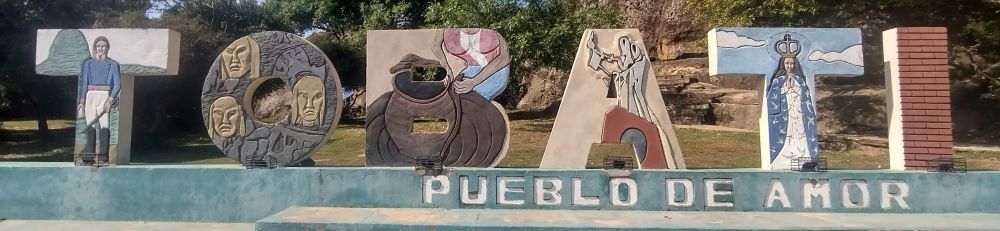
Tobatí, Paraguay
June 28, 2023
Tobatí, Paraguay, has a population of about 35,000. The town was founded in 1539 by Domingo Martínez de Irala. The original name of the town was Tavá, and it was founded about 32 kilometers north on the banks of the Paraguay River.
The economy of Tobatí depends primarily on the manufacturing of clay bricks, blocks, and tiles. There are several very large companies and many, many small manufacturers, and countless family-run operations as well. The clay is mined about 7 or 8 kilometers outside the town. I walked through an area at the edge of town that was endless manufacturing plants, there are photos in the photo album. I stopped at a couple of the big ones to look around and a few of the workers chatted with me but only very briefly. I stopped at a much smaller operation and chatted with some workers and they showed me inside a kiln they were filling with fresh bricks. Then another man appeared and he was the owner. He gave me a tour of the plant. We started at the pile of clay and he showed me the machine that has the form for the most common block, then he showed me another machine that pressed out bricks. Then we walked through a building that was loaded with thousands of bricks and blocks, raw clay, waiting and air-drying until they could go into a kiln. I stopped at an even smaller operation and the owner showed me how he hand-makes bricks, lays them out in the open air so they can mostly dry, then they go into a kiln, which I thought wasn't usable due to its appearance. But, I was wrong, and it was still in use daily. These kilns are common, they're even in yards in the city, where families make bricks to sell. The kilns are wood-fired. They burn eucalyptus wood, and scattered all over Paraguay are many eucalyptus tree farms. But, no matter how many they plant, tree farms are not sustainable, and the tree farms and clay mines are getting further from town, so the cost of manufacturing is always increasing. There is also a large amount of pottery manufacturers here, mostly small artisans. One of the negative aspects of the clay brick manufacturers is the smoke from all the kilns, which causes are fair amount of air pollution. And the truck traffic through the small town is crazy, not just the noise but also the air pollution they cause.
Tobatí has a warm temperate climate. The average daytime high of 29° C (83° F), and the nightly average low of 18° C (66° F). The city's elevation averages 91 meters (298 feet). The average yearly rainfall amounts to 1831 mm (72 inches) of rain.
So, my impressions: Tobatí is a pleasant town. But, in regard to the points I mentioned above, not a place I would choose to live—the noise and traffic from the heavy trucks and the air pollution from the many kilns and again, the many trucks.
My goal is to find a new place to live. So to reach that goal, I am traveling most of South America, visiting the countries of Ecuador, Perú, Bolivia, and Chile, passing through Argentina, visiting Paraguay, passing through a bit of Brazil, and finally visiting Uruguay. I have a list of towns, about 70 that meet these qualifications: Cities with average day temperatures of 22-28° C (72-83° F) and night temps of 14° C (57° F) and higher; and a population between 28,000-300,000. I analyzed climate and population data of around 700 towns in the countries mentioned above and then pulled out the ones that meet the previously mentioned criteria, which leaves about 70. My preference leans towards towns of less than 100,000 people. And, now that I have visited more than 30 towns/cities, I've decided I will probably want an inland town. I love the beach and walking in the warm water, but getting sunburned is just too easy, even on a cloudy day. At least here in Ecuador. I've also decided that any town with more than 100,000 population will be too big. I've decided that any small town/city (less than around 80,000 population) that meets the temp specifications and has a supermarket and ATM is one worth considering to live in.
My goal is to visit the towns and discover which one calls out to me - "Chip, Chip, make your new home here, this is your new home town". That hasn't happened yet, but the towns listed below are very close to giving me that feeling. At any rate, I am not visiting tourist attractions or archeological sites, etc, those will have to wait for another trip through South America.
At this point in my journey, I had ten towns on my Top 10 list, but I narrowed it down to four:
- Tingo Maria, Perú
- Moyobamba, Perú
- Catamayo, Ecuador
- Puyo, Ecuador
During my travels in Ecuador I visited 32 towns/cities. In Perú, I visited 26 towns/cities; in Chile, only five towns; and in Argentina, I visited 15 towns. In Uruguay, I visited five towns, and in Brazil, three. So far, I have visited 22 cities in Paraguay.
Next up: Atyrá, Paraguay.

I used to teach English as a foreign language in Barranquilla, Colombia. Now I'm retired and traveling throughout South America.
I'm from Kennewick, Washington, USA. In my previous life, as I call it, I was an IT guy, systems administrator, computer tech, as well as a shipping/receiving guy and also worked as a merchandising guy in a RV/Camping store.