My Books on Amazon






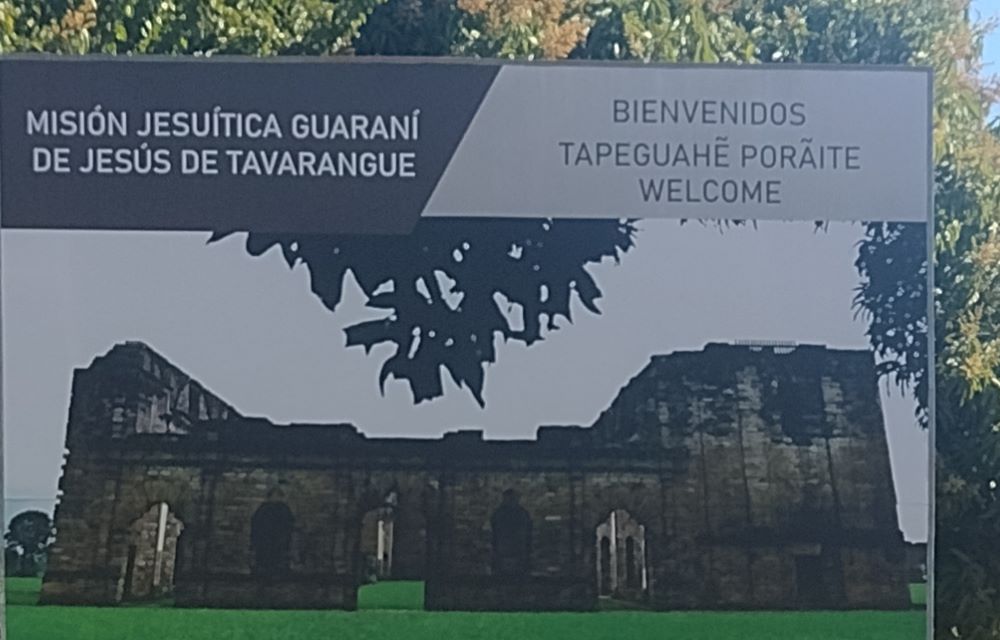
Jesús De Tavarangue Ruins and town
June 19, 2023
The town of Jesús was founded on the sideof the Monday River on January 1, 1685. But the following yearthe Jesuit Father Jerónimo Delfín and the 150Guaraní families moved to Ibaroty. The town was moved threemore times until in 1748 they arrived at the place where thecurrent town of Jesús is located today. This location turnedout to be the definitive one since the expulsion of the Jesuitsended the plans to transfer the Mission again.
Around the Plaza Mayor, part of the newchurch, the College, the Coty Guazú, and the foundations ofthe new houses were built, but they were never completed. Becauseit was never completed they say the Mission "a great unfinishedwork."
The initial plans of the church were probably due to the curate Brother Joseph Grimau. But there is more documentation available about the work done by Antonio Forcada, a Spanish architect, born in Zaragoza in 1701.
The various plaques that I found are translated in the following paragraphs.
The first plaque: "The Mission of Jesús was declared, together with Trinidad, World Heritage by UNESCO in 1993 and is considered one of the most important buildings of the 30 Jesuit towns established in the region.
This property was registered under No. 648 and based on cultural criterion IV, which provides as follows:
'To be an outstanding example of a type of construction, of anarchitectural, technological or landscape ensemble, which illustrates one or more significant stages in the history of Humanity.'
In addition to their artistic interest, these missions represent the social and economic initiatives that accompanied the Christianization of the Río de la Plata basin by the Society of Jesús in the 17th and 18th centuries."
The second plaque: "JESÚS GUARANÍ MISSION "JESÚS DE TAVARANGUE"
The town of Jesús was founded on the banks of the Monday River on January 1, 1685. The following year, the Jesuit father Jerónimo Delfín and the 150 Guaraní families that originally formed it, moved to Ibaroty.
Three more moves followed one another until, in the year 1748,they arrived at the place where the town of Jesús is located today. This location turned out to be the definitive one since the expulsion of the Jesuits in 1767 truncated new transfer plans.
More than ruins, it is correct to speak of Jesús as a great unfinished work, since around the Mayor, part of the new church of the Coty Gunze College was built, the foundations of the old houses, but the works have never been doubted."
And the third plaque: "The enhancement of the Mission of Jesús
Since the expulsion of the Jesuits from the Spanish territories motivated by an intrigue of political and economic interests, the population of the towns under their charge had been decreasing.
The construction works of Jesús, paralyzed and abandoned at the end of the 18th century, deteriorated due to the action ofthe weather and the lack of maintenance for more than two centuries.
A first systematic cleaning was carried out in the 1960s and justa decade later the architect Graciano Gasparini made the first survey of the complex. From 1981 to 1985 various consolidation, chemical cleaning and sealing interventions were carried out onpillars and facades.
At the beginning of the 1990s, an agreement was signed between the Ministry of Culture, the Directorate of Tourism and the Spanish Agency for International Cooperation for a series of interventions to enhance the Heritage of the Guaraní Jesuit Missions of Paraguay, taking into account its possible cultural, economic, and social profitability.
The pilot project of the agreement was the Mission of Jesús. This intervention, in which the contribution of Zoraida Mesquita was highlighted, served as the basis for other successful actions in defense of our heritage carried out in agreement with the AECID. One of them is the one that has given rise to this Museum that treasures and exhibits the objects found during the excavations carried out here."
This Mission is a similar sized area as the Trinidad Ruins I visited a couple of days ago (see the blog from two days ago), but there are far fewer buildings. The amount time needed to visit this was much less than the Trinidad site.
Before I went to the ruins I went to the bus terminal in Encarnación to get some information. I was told to take a bus to Obligado to the terminal there, then get a bus from that terminal to the Ruins. Well, those instructions were wrong. So, here's how to get to the Ruins of Jesús - take a bus from Encarnación to Obligado, get off the bus as it is passing the main town area (a fork in the highway), and walk to the supermarket, maybe a 15 minute or so walk. (The bus terminal is only a couple of blocks away from the supermarket, but don't goto the bus terminal.) Wait for a micro-bus across the street from the supermarket, in front of a small miscelaneous store. That micro-bus will have a sign in the window that says "Obligado Jesús." That bus will first go to Trinidad, past the road to the Ruins, continue to the Trinidad entry and make a u-turn. As it returns it will turn on the road that goes out to the Ruins. Stay on the bus because it will take you directly to the entrance. You will also get the bus in the same place, the parking lot, to return to Obligado. Now, you could get a bus to Trinidad, wait for the Jesús bus to arrive and go to the Ruins, but there is a good chance that the bus driver will decide to make his u-turn at an earlier point in the road. I suggest you simply go to Obligado. When returning you could get off at Trinidad and again wait for any bus that has a sign for Encarnación in the window. The cost is either 20 or 25 mil guaranies depending on the bus, from Encarnación to Obligado or Trinidad. The cost from Obligado to the Ruins on the micro-bus was 10 mil guaranies.
Between these two Ruins - Jesús and Trinidad, the better, must-see, is the Trinidad Ruins.

I used to teach English as a foreign language in Barranquilla, Colombia. Now I'm retired and traveling throughout South America.
I'm from Kennewick, Washington, USA. In my previous life, as I call it, I was an IT guy, systems administrator, computer tech, as well as a shipping/receiving guy and also worked as a merchandising guy in a RV/Camping store.