My Books on Amazon






Santísima Trinidad del Paraná
June 17, 2023
One of the first information signs you willsee in the park says this: "This mission stands out for itsmajesty and grandeur. It represents the baroque thatcharacterizes the construction of the temple decorated withsymbos and signs. The Guaraní Corregidores of that time areburied in its central nave.
The grandeur of the Plaza Mayor is an indication that it has beenthe center of demonstration of power, where parades of armies,large processions, theatrical and musical performances wereheld."
Another sign says this: "The Jesuit mission ofSantísima Trinidad del Paraná is the best preservedGuaraní reduction in Paraguay andthe most extensive. It islocated on a hill 28 kilometers northeast of Encarnacion in thedistrict of Trinidad in Itapúa; it is accessed from theRoute 6.
It was founded in 1706, and in 1728 it had a population of 3,000indigenous Guaraní. It was rediscovered nearly two centuriesafter it was abandoned, and it was declared a World Heritage Siteby UNESCO in 1993.
It has a Plaza Mayor, a meeting place for th epoeple, and aJesuit Museum located in the old sacristy where you can seesculptures and a model of the mission. This reduction has thelargest temple built among all those that make up the Jesuitreductions, where the frieze of the musical angels stands out,which until the discovery of musical scores in Moxos (Bolivia)constituted the only antecedent of music in the Jesuitmissions.
This town is the one that preserves the structure of the town toa greater degree. The architect of the main church was GiovanniBautista Primoli, who was also in charge of the design of anyreduction.
It has a Plaza Mayor, around which the rest of the mission isentered. On the main side was the main church, the cemetery, theorchard and other buildings and on the sides that are theindigenous and the viewpoint."
Another sign has this information: "Thisdestination houses precious treasures bequethed by our ancestors.There are eight Jesuit missions that are part of the territory ofthe Jesuit Route of Paraguay. They settled around the 1800s andremain until today, as a trace and symbol of an era thatcontributed greatly to the social and cultural promotion of theindigenous Guaraní who inhabited Paraguayan soil at thattime.
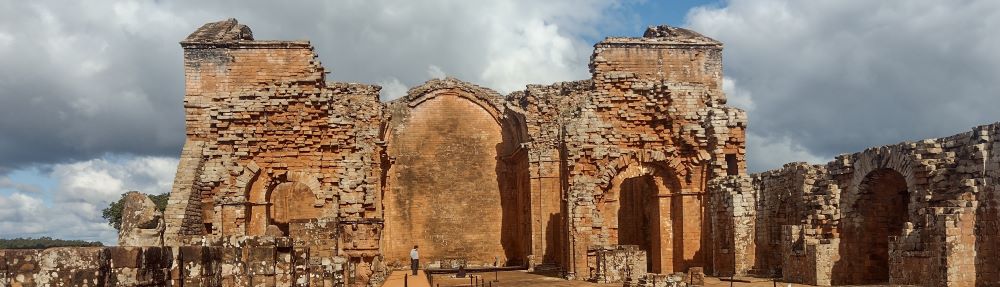
In the museum at the side of the church onewill find many artifacts of the mission, and the first plaquesays this about the main church (the biggest building in thephotos): "The Church, which we have just visited, was one of thelargest and most beautiful of all the Guarani Jesuit Missions andthe only one to be built entirely of stone, closely following theguidelines and morphology of the European Baroque architecture ofthat time.
It was designed in 1745 by the Italian architect Juan BautistaPrimoli, coadjutor brother of the Society of Jesus and built bythe Guarani. The vaults that covered its naves, the dome thatrose above the transept, its altars, friezes and ornaments, wereall designed together and made of carved stone, which was anovelty and a marvel that was never repeated in all of thehistory of Paraguayan architecture.
But even before the expulsion of the Jesuits, it began to havestructural problems. The foundations were insufficient for theenormous weight resting on an unstable ground. The stone domecollapsed in one night. And although it was soon rebuilt withbrick and lime, the process of destruction proceeded inexorably.Worse still, the loss of the Church was accelerated by theineptitude of the new administrators who had to take charge ofthe people of Trinidad after the expulsion of the Society ofJesus decreed in 1767.
Finally, the facade was dismantled and the roofs collapsed.Its remains were used for new constructions or were abandoned andexposed to theft and systematic looting. The monumental carvingsand construction remains, which fortunately remained hidden,buried in the rubble for two centuries, were finally recoveredand stored.
A part of them, today is exhibited in this Museum, as aninterpretive sample that values the importance of this churchand that at the same time pays a just homage to the guaranigenius that flourished with undeniable enthusiasm unconcealable under jesuitan inspiration."
Another plaque in the museum has this information about the church architecture: "The architecture of the Church of Trinidad.
We could say that the church of Trinidad is a typical design of Italian Baroque architecture transplanted to our lands. The project created by the Milanese Jesuit Juan Bautista Primoli, far from being imposed, was enthusiastically accepted by the Guaraní. It was assumed and resolved with unprecedented academicism and with original touches that border on genius.
To understand Trinidad, it is necessary to take into account the basic guidelines of the European Baroque architecture of that time: The entire city was designed as a backdrop for urban festivities and the facades were created to frame you and govern the space that surrounded them. This church dominated in a royal way and without linolic, the entire main square of Trinidad.
From its remains we can infer that its façade, like many Jesuit constructions, was based on the Il Gai Church, the headquarters of the Order of the Society of Jesus in Rome, place of the tomb of its founder Saint Ignatius of Loyola.
Trinidad is a temple with a basilica floor plan and three naves: a central one and two lateral ones. The transept is resolved in a transept that does not protrude from the rectangular plane in the center of which stands the dome, the most difficult and desired component of Baroque architecture.
Inside, created with arches and stone vaults on massive pillars, a decorative program of classical language is developed. Architraves with friezes on paired pillars without tectonic function alternate with homacinat, window frames and doors framed by reliefs from the traditional clinical repertoire but used with freedom and originality."
And another plaque in the museum tells us more about the architecture: "Trinidad in Paraguayan architecture
Paraguayan architecture, a fusion of Guaraní and Spanish construction traditions, was eminently pragmatic from its beginnings, using all the materials it found within its reach.
To the wood and vegetable fibers they added the adobe walls, but the tile roofs continued to be supported by huge posts in the form of a huge wooden frame. Then it was the brick walls that supported the roofs, and this system became our traditional and characteristic way of building, which has remained in force ever since.
And this is where the originality of this church lies within Paraguayan architecture. Trinidad was the first attempt -albeit unsuccessful- to solve the floors, walls and ceilings with the same material: itaquí stone or red grit.
Arches were formed with large ashlars, and vaults and domes were raised, structuring and covering the entire space without resorting to another material. A formula that has been successfully tested in Europe since ancient times and has always been used for the most important buildings and destined to last for centuries.
A tradition clearly implanted in our native soil, but which undoubtedly aroused among our Guaraní a civic and religious enthusiasm only comparable to that which gave rise to the great cathedrals of the Middle Ages."
Timeline for the Mission:
1706: The Jesuit priest Juan de Anaya, together with 608 Guaraní families, who broke away from the mission of San Carlos, founded Santísima Trinidad together in a place near the Uruguay River.
1712: In search of better lands, the people of trinidad cross the Paraná River and settle in this place.
1728: The Santísima Trinidad mission exceeds 3,000 inhabitants.
1740-1744: Juan Bautista Primoli projects and begins the construction of the Church of Trinidad.
1747: Primoli passed away. the work was carried out by Antonio Forcada, José Grimau, Jaun A. de Rivera, and Pedro Danesi.
1749: The stone dome collapses and is later rebuilt with bricks and lime.
1760: The works of the temple are finished.
1765: The church is inaugurated but the ornamentation work continues.
1768: The Order of the Jesuits is expelled from all Spanish domains. The religious Order of Santo Domingo takes charge of Trinidad for a short period of time.
1773: General Administrator of the Spanish Crown, Jaun Angel de Lazcano, faced with the danger of demambe, dismantled the facade, which accelerated the collapse of the vaults and the destruction of the entire church.
1776: The church is definitely ruined. A new temple is built, the one we see today next to the main square.
1788: Only 57 families live in the town of Trinidad and the new temple also began to fall into disrepair, but it was repaired and kept in use until the end of the 19th century.
1889: Adolfo de Bourgoing, affiliated with the Museo de La Plata, buys 34 images from the caretakers of the mission that are now kept in that Argentine museum.
1948: The Argentine artist Liber Fridman collects a large number of drawings and photographs of Trinidad.
1966: A report was made about the alarming condition of the ruins.
1973: The architect Gasparini carries out a test excavation and prepares a general project for the enhancement of Trinidad.
1974-1980: The engineer Roberto Vera Vierci and the architect Jorg Patiño carry out excavation, cleaning and consolidation tasks, continued by the restorer from Senator Zoraida Mesquita. With the rescued stone elements, this Museum is created.
1981: The archaeological excavations of José Perasso began, financed by the OEA, Paracuaria, and Senator.
1993: The Santísima Trinidad del Paraná Mission is declared a World Heritage Site by UNESCO.
All of the above translations are from Google Translate online. I used my phone Google translate app to take a picture of the text which it then translated to English, and I transcribed into the webpage. I hope you found it as interesting as I have. Please be sure to look at the photo album called Trinidad Ruins, there are many pics of the Mission.

I used to teach English as a foreign language in Barranquilla, Colombia. Now I'm retired and traveling throughout South America.
I'm from Kennewick, Washington, USA. In my previous life, as I call it, I was an IT guy, systems administrator, computer tech, as well as a shipping/receiving guy and also worked as a merchandising guy in a RV/Camping store.