My Books on Amazon






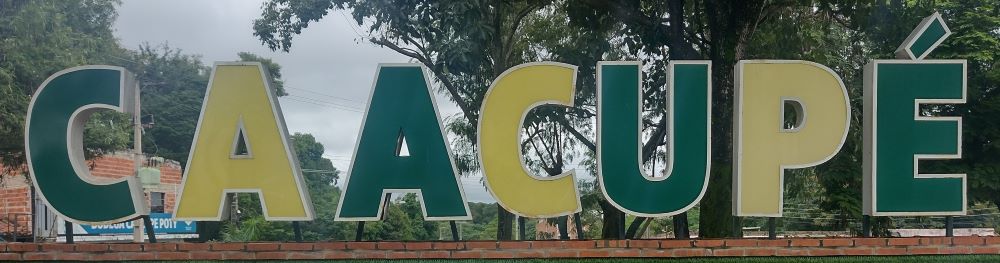
Caacupé, Paraguay
May 5, 2023
Caacupé, Paraguay, population: 26,000, but the metropolitan area/district is about 57,000 people. The nickname for the city is "Spiritual Capital of Paraguay". The church is the Minor Basilica of Caacupé and it receives many thousands of people coming here for the celebration of the Immaculate Conception of Mary, December 8. The church is of a stiking architecture, check out the pics in the photo album.
The city was founded in April 1770, but the historical story goes back to 1600. It talks about a man, Jesés, who went out into the jungle to search for food and wood, but he wandered into inhospitable territory. He was chased by the Mbaya people but they lost track of him when he hid behind a large tree trunk. He then prayed and asked the Virgin Mary to deliver him from certain death. The Mbayas couldn't find him, and he was saved to live another day. A miracle had taken place. So José took a piece of the tree bark home with him and formed a beautiful sculpture of the Virgin Mary. He and his family settled in that valley with the assurance that the Virgin Mary would always look after them. He built a small chapel which drew people from around the area. Many people settled in the same area, and the town was born, and was named Ytuenses. By 1765, the valley was already known as the Valley of Caacupé (in Spanish caacupé means "behind the mountain"). As the town grew, they had to build a bigger chapel, which was completed in 1770. Upon completion in April, that date was given as the date of founding for the town.
The city's economy is supported by a small candy industry, mineral water bottling, agriculture, livestock, and some tourism. To a lesser extant - forestry, flowers, wood and leather crafts, and ceramics.
Caacupé has a warm and temperate climate, but also a subtropical climate because of its altitude. The average daytime high of 27° C (81° F), and the nightly average low of 18° C (64° F). The city's elevation averages 179 meters (587 feet). The yearly average rainfall amounts to 1,536 mm (60.5 in).
So, my impressions: I like Caacupé. The town has two plazas, the one in front of the church is very open with no statues, monuments, or fountains, not even any benches, but it does have lots of trees. The other plaza is the main town square and is very nice. It is surrounded by restaurants, ice cream shops, and other small businesses. The town is build around those two plazas. Caacupé is also a little hilly, which is a nice change from the previous towns I visited here in Paraguay, where are flat as pancakes. I also find the Spanish spoken here esier to understand than the Spanish spoken in those previously visited towns. But it's still more difficult than the Spanish in Colombia, Ecuador, and Perú. Another point of interest—most, if not all, of the old cobblestone streets have been replaced or overrlayed with asphalt. Which, as I'm a cyclist, is a good thing, or would be if I were to live here. I also noticed the streets are clean and have very little litter.
My goal is to find a new place to live. So to reach that goal, I am traveling most of South America, visiting the countries of Ecuador, Perú, Bolivia, and Chile, passing through Argentina, visiting Paraguay, passing through a bit of Brazil, and finally visiting Uruguay. I have a list of towns, about 70 that meet these qualifications: Cities with average day temperatures of 22-28° C (72-83° F) and night temps of 14° C (57° F) and higher; and a population between 28,000-300,000. I analyzed climate and population data of around 700 towns in the countries mentioned above and then pulled out the ones that meet the previously mentioned criteria, which leaves about 70. My preference leans towards towns of less than 100,000 people. And, now that I have visited more than 30 towns/cities, I've decided I will probably want an inland town. I love the beach and walking in the warm water, but getting sunburned is just too easy, even on a cloudy day. At least here in Ecuador. I've also decided that any town with more than 100,000 population will be too big. I've decided that any small town/city (less than around 80,000 population) that meets the temp specifications and has a supermarket and ATM is one worth considering to live in.
My goal is to visit the towns and discover which one calls out to me - "Chip, Chip, make your new home here, this is your new home town". That hasn't happened yet, but the seven towns listed below are very close to giving me that feeling. At any rate, I am not visiting tourist attractions or archeological sites, etc, those will have to wait for another trip through South America.
At this point in my journey, I have ten towns on my Top 10 list (I may have to change it to a top 15 list):
- Tingo Maria, Perú
- Moyobamba, Perú
- La Merced, Perú
- Catamayo, Ecuador
- Puyo, Ecuador
- Formosa, Argentina
- Caacupé, Paraguay
- Itá, Paraguay
- Itauguá, Paraguay
- Areguá, Paraguay
In my travels in Ecuador, I visited 32 towns/cities. In Perú, I visited 26 towns/cities; in Chile, only five towns; and in Argentina, I visited 13 towns. I have now visited eight cities in Paraguay.
Next up: Coronel Oviedo, Paraguay.

I used to teach English as a foreign language in Barranquilla, Colombia. Now I'm retired and traveling throughout South America.
I'm from Kennewick, Washington, USA. In my previous life, as I call it, I was an IT guy, systems administrator, computer tech, as well as a shipping/receiving guy and also worked as a merchandising guy in a RV/Camping store.