My Books on Amazon






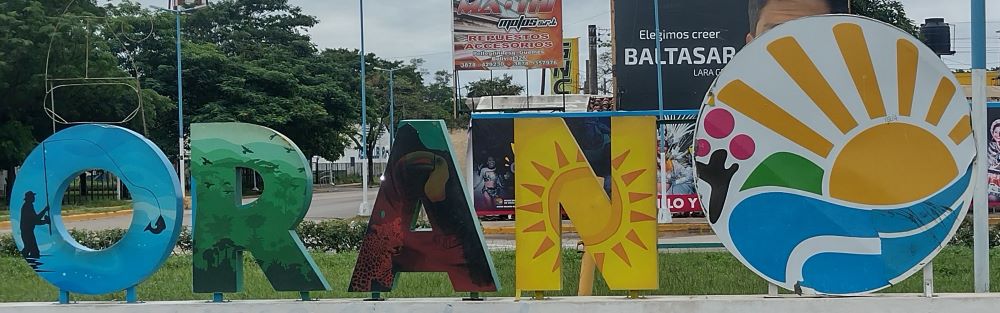
Orán, Argentina
April 15, 2023
San Ramón de la Nueva Orán, Argentina, population: about 76,000. Orán is a political center for the department of Salta, it has a federal courthouse, as well as banks, universities, and other important offices. It is a commercial center of northern Salta province. Orán is the center of an important agro-industrial region: sugar cane, used mostly for the production of sugar in the Tabacal sugar mill. Tabacal a town near the city. Other important commodities include citrus, mainly oranges and grapefruit.
Prior to the 17th century and into the 18th, the area was inhabited by various indigenous groups which sometimes formed alliances and at other times fought against each other. The Spanish arrived in the 17th century and tried to inhabit and conquer the area but were faced with fierce resistance from the locals who wanted nothing to do with the newcomers. In 1779, the Franciscans formed a new town and cultivated grapes, sugar cane, and citrus fruits. At this time the Spanish managed to build a fort but within 10 years the indigenous people destroyed it all. It was in 1794 that the Spaniard Pizzaro finally made a final take-over of the region. The new incoming population cemented the take-over and Orá became a hub between the cities of Salt, Argentina, and Tarifa, Bolivia. In 1794, a map of the new town was created either by Pizzaro or someone close to him, and that original map is stored in the Library of Congress in the USA. In 1819, Argentine patriots liberated the city from Spanish control and captured Pizzaro, because he was loyal to Spain. He was confined to live out his life here in Oran only. There had been two major earthquakes in the Orán area, in 1871 and 1874, both of which devastated the city. Many people left Orán after the second earthquake. The town spent many years recuperating and rebuilding, well into the 20th century. Eventually, the railway arrived, the cathedral was built, the airport was inaugurated, and the regional headquarters of the University was created. The San Vicente de Paul Hospital was inaugurated in 1980, it covers an area of 1 hectare (2.5 acres).
Orán has a humit subtropical climate. The average daytime high of 27° C (81° F), and the night average low of 17° C (63° F). The city's elevation is 336 meters (1102 feet).
So, my impressions: Orán, while being more than 200 years old, has essentially no old/historical buildings. The main church at the central plaza is relatively new. All the original buildings had been destroyed by the two before-mentioned earthquakes. The town has a few nice parks and plazas, but not many neighborhood parks. The climate is excellent, though on the days I was here there was light rain in the mornings and late afternoons. The streets are clean and litter-free, but there are so many dogs running around that I cannot put this town on my list of potential new hometowns.
My goal is to find a new place to live. So to reach that goal I am traveling most of South America, visiting the countries of Ecuador, Perú, Bolivia, and Chile, passing through Argentina, visiting Paraguay, passing through a bit of Brazil, and finally visiting Uruguay. I have a list of towns, about 70, that meet these qualifications: Cities with average day temperatures of 22-28° C (72-83° F) and night temps of 14° C (57° F) and higher; and a population between 28,000-300,000. I analyzed climate and population data of around 700 towns in the countries mentioned above and then pulled out the ones that meet the previously mentioned criteria, which leaves about 70. My preference leans towards towns of less than 100,000 people. And, now that I have visited more than 30 towns/cities, I've decided I will probably want an inland town. I love the beach and walking in the warm water, but, getting sunburned is just too easy, even on a cloudy day. At least, here in Ecuador. I've also decided that any town with more than 100,000 population will be too big. I've decided that any small town/city (less than around 80,000 population) that meets the temp specifications and has a supermarket and ATM is one worth considering to live in.
My goal is to visit the towns and discover which one calls out to me - "Chip, Chip, make your new home here, this is your new home town". That hasn't happened yet, but the seven towns listed below are very close to giving me that feeling. At any rate, I am not visiting tourist attractions or archeological sites, etc, those will have to wait for another trip through South America.
At this point in my journey I have five towns on my Top 10 list - Tingo Maria, Moyobamba, La Merced, Perú, and Catamayo and Puyo, Ecuador. In my travels in Ecuador, I visited 32 towns/cities. In Perú, I visited 26 towns/cities, in Chile, only five towns, and now in Argentina, I've visited ten towns.
Next up: Tartagal, Argentina.

I used to teach English as a foreign language in Barranquilla, Colombia. Now I'm retired and traveling throughout South America.
I'm from Kennewick, Washington, USA. In my previous life, as I call it, I was an IT guy, systems administrator, computer tech, as well as a shipping/receiving guy and also worked as a merchandising guy in a RV/Camping store.