My Books on Amazon






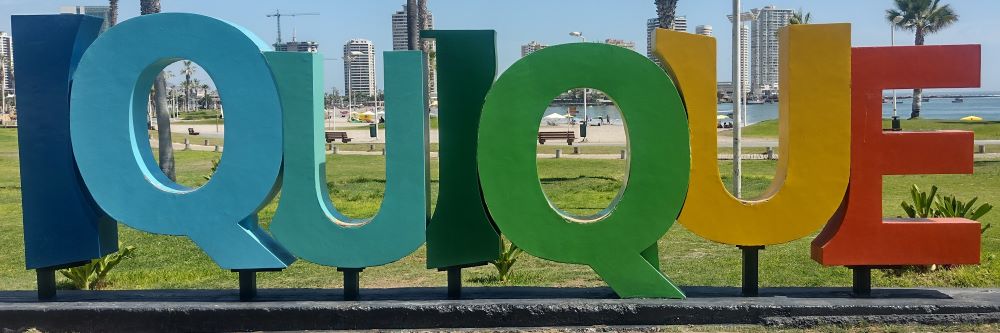
Iquique, Chile
March 28, 2023
Iquique, Chile: population: about 190,000. Back in the early 1880s, there was a war between Chile and Perú, and Iquique and the regions north of it were taken by Chile.
The history dates back to something like 7000 years BC. Iquique and other towns of northern Perú owe their existence to saltpeter mining. In 1835, Charles Darwin visited Iquique and apparently wasn't very impressed with what he saw, he said, Iquique is a town "very much in want of everyday necessities, such as water and firewood". The city's economy now relies on commercial and port activities as well as tourism.
Iquique has a desert climate. The average daytime high of 22° C (71° F), and the night average low of 17° C (53° F). The city's elevation is 1 meter (3 feet) and averages 1 mm (.04 inches) of rain per year. Yes, .04 of an inch of rain for the entire year! How do they even measure such a little amount?
So, my impressions: Iquique is both a beach and desert city. And it sits barely above sea level. If there ever is a tsunami here this city would be literally wiped off the face of the earth. The city has the ocean on one side and steep almost cliff-like hillsides around the read of the city. And they are high. A giant wave would hit the city then hit the hillside "walls" and bounce back and hit the city again as the water was still pouring in from the ocean. It would be a 100% wipe-out erasure of a city. Would I choose to live here? No. Other than that, the city is a tourist city with lots of beach-side condos and apartment buildings, and long beaches (though some have water and waves that are rough and dangerous so swimming is not allowed). The city is generally clean, especially the city center, and there are many buildings and houses that date back to the 19th century. One difference here is these old houses are wood-framed and sided, unlike in Perú, Ecuador, and Colombia, where I saw something like 99.99% of the houses made of masonry. I wonder where the wood came from? This is a desert with absolutely no plant growth of any kind. Here in the city, the plant life has all been brought in by people.
My goal is to find a new place to live. So to reach that goal I am traveling most of South America, visiting the countries of Ecuador, Perú, Bolivia, and Chile, passing through Argentina, visiting Paraguay, passing through a bit of Brazil, and finally visiting Uruguay. I have a list of towns, about 70, that meet these qualifications: Cities with average day temperatures of 22-28° C (72-83° F) and night temps of 14° C (57° F) and higher; and a population between 28,000-300,000. I analyzed climate and population data of around 700 towns in the countries mentioned above and then pulled out the ones that meet the previously mentioned criteria, which leaves about 70. My preference leans towards towns of less than 100,000 people. And, now that I have visited more than 30 towns/cities, I've decided I will probably want an inland town. I love the beach and walking in the warm water, but, getting sunburned is just too easy, even on a cloudy day. At least, here in Ecuador. I've also decided that any town with more than 100,000 population will be too big. I've decided that any small town/city (less than around 80,000 population) that meets the temp specifications and has a supermarket and ATM is one worth considering to live in.
My goal is to visit the towns and discover which one calls out to me - "Chip, Chip, make your new home here, this is your new home town". That hasn't happened yet, but the seven towns listed below are very close to giving me that feeling. At any rate, I am not visiting tourist attractions or archeological sites, etc, those will have to wait for another trip through South America.
At this point in my journey I have six towns on my Top 10 list - Tingo Maria, Moyobamba, La Merced, Perú, and Catamayo and Puyo, Ecuador. In my travels in Ecuador, I visited 32 towns/cities. In Perú, I visited 26 towns/cities.
Next up: Calama, Chile.

I used to teach English as a foreign language in Barranquilla, Colombia. Now I'm retired and traveling throughout South America.
I'm from Kennewick, Washington, USA. In my previous life, as I call it, I was an IT guy, systems administrator, computer tech, as well as a shipping/receiving guy and also worked as a merchandising guy in a RV/Camping store.