My Books on Amazon






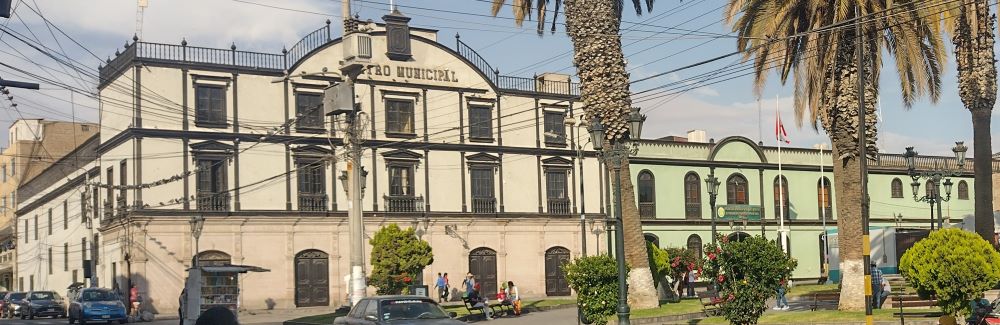
Tacna, Perú
March 24, 2023
Tacna, Perú: population: about 325,000. Tacna is a desert city in the far south of Perú. Tacna was founded in June 1855.
The Tacna area has been occupied for many centuries by various indigenous groups. Around the year 800 the Incas came into the area and "settled" it. Then later, the Spaniards arrived and they "settled" it, again, in 1572. The first church was built in 1679. Over the years there had been many wars and battles between Perú and Chile and Tacna was typically right in the middle of them all. It wasn't until 1929 that the Tacna region was incorporated into Perú.
Tacna produces 53% of Perú's olives and a large part of its economy is from agriculture. That is followed by dairy farming, sheep, fishing, and copper mining.
At least six different dances originate from the Tacna area. Aside from the common holidays, there are also numerous festivals that are specific to the Tacna region, with at two of them specific to farmers. And finally, Tacna has quite a list of places of interest to tourists including sites in the city and outside the city.
Tacna has a temperate subtropical climate. The average daytime high of 23° C (73° F), and the night average low of 14° C (57° F). The city's elevation is 562 meters (1844 feet) and averages 26.2 mm (1.03 inches) of rain per year.
So, my impressions: Tacna is an interesting small city and a good place to visit. There are many historical buildings and interesting architecture to learn about. The city center is clean and pleasant with lots of nice green space and parks. But, when you get out to the suburbs things change a bit - litter in the streets and less-than-great parks. It's not a place for me to consider as a new home, but well worth a visit.
This is my goal: to find a new place to live. So to reach that goal I am traveling most of South America, visiting the countries of Ecuador, Perú, Bolivia, and Chile, passing through Argentina, visiting Paraguay, passing through a bit of Brazil, and finally visiting Uruguay. I have a list of towns, about 70, that meet these qualifications: Cities with average day temperatures of 22-28° C (72-83° F) and night temps of 14° C (57° F) and higher; and a population between 28,000-300,000. I analyzed climate and population data of around 700 towns in the countries mentioned above and then pulled out the ones that meet the previously mentioned criteria, which leaves about 70. My preference leans towards towns of less than 100,000 people. And, now that I have visited more than 30 towns/cities, I've decided I will probably want an inland town. I love the beach and walking in the warm water, but, getting sunburned is just too easy, even on a cloudy day. At least, here in Ecuador. I've also decided that any town with more than 100,000 population will be too big. I've decided that any small town/city (less than around 80,000 population) that meets the temp specifications and has a supermarket and ATM is one worth considering to live in.
My goal is to visit the towns and discover which one calls out to me - "Chip, Chip, make your new home here, this is your new home town". That hasn't happened yet, but the seven towns listed below are very close to giving me that feeling. At any rate, I am not visiting tourist attractions or archeological sites, etc, those will have to wait for another trip through South America.
At this point in my journey I have six towns on my Top 10 list - Tingo Maria, Moyobamba, La Merced, Perú, and Catamayo and Puyo, Ecuador. In my travels in Ecuador, I visited 31 towns/cities. In Perú I visited 26 towns/cities.
Next up: Arica, Chile.

I used to teach English as a foreign language in Barranquilla, Colombia. Now I'm retired and traveling throughout South America.
I'm from Kennewick, Washington, USA. In my previous life, as I call it, I was an IT guy, systems administrator, computer tech, as well as a shipping/receiving guy and also worked as a merchandising guy in a RV/Camping store.