My Books on Amazon






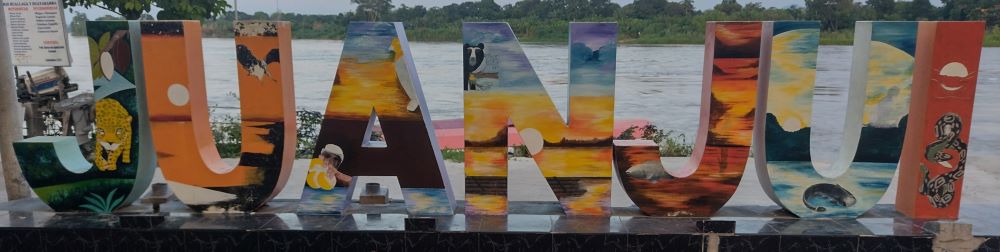
Juanjuí, Perú
February 8, 2023
Juanjuí, Perú: population: 30,000, or about 35,000 for the entire metropolitan area. Juanjuí sits in a mountain valley at 283 meters (928 feet). It's a very pretty valley and quite close to the Amazon region. Juanjuí is the gateway into one of the national park Rio Abiseo and the ruins Gran Pajaté. The history of the region dates back to the Inca years, but it was in 1827 that the Spanish conquered the area and founded the town. The name Juanjuí is a contraction of the name Juan Huido. The Spanish founded the town with this name: Villa de Santa María de la Merced de Juanjuí, Sworn Protector of the Captives. The growth of the town didn't really take off until the highway was built in 1956, prior to which the airport was the only way to reach the town.
In 1972, there was an earthquake that caused damage to 80% of the homes in Juanjuí. In 2011 Juanjuí received national and international awards for its production and export of organic cocoa (from which we get chocolate, not that white powdery stuff). The economy of Juanjuí comes mostly from commercial trades/businesses, followed by agriculture: cocoa (the production of which is considered some of the best in the world), oranges, papayas, cotton, cassava, bananas, lemons, etc. Tourism is not a big part of the picture here but the city is in the construction mode of a new malecon, a riverside walkway that will extend the length of the city along the river. There are a few pics in the photo album.
Juanjuí has a hot humid climate. The average daytime high of 29° C (85° F), and the night average low of 21° C (70° F). The elevation of the city is 283 meters (928 feet). Juanjuí averages 165 mm (6.5 inches) of rain per month. That sounds like a lot, and maybe it is, but during my 3 or so days here it rained once during daytime hours and lasted for about 10 minutes, but it was quite heavy for those 10 minutes. And it rained a bit one late evening.
So, my impressions: Throughout my few days here I have been flagging between yes or no in regards to putting Juanjuí on my top 10 list. Now, at the end of my stay, I think I will put it in the 10th position. I like the town, I like the valley it sits in, and I like the climate. The one part that doesn't let me be completely sold on it is this: no real supermarket. there are a couple of large miscellaneous stores that also have grocery sections, a decent small grocery store, and many tiendas, of course. There are also markets where you can get just about any you need. The town does have several different ATMs that do accept my debit card, so that is a plus. They are also building a new park that will have many permanent booths for vendors of artisanal goods and cultural displays. Part of the park is completed (pics in the photo album), another part is in construction, and the last part is currently used for soccer, volleyball, and picnicking. There are two nice plazas, as well. Everybody I met while visiting stores or just out walking was friendly and open to talking with me even with my not-so-great command of Spanish which I learned in Colombia. I mention that because each country has a slightly different version of Spanish, even some differences in vocabulary. It's been interesting, so far, and I'm sure it will be more so when I get into the next countries.
This is my goal: to find a new place to live. So to reach that goal I am traveling most of South America, visiting the countries of Ecuador, Perú, Bolivia, and Chile, passing through Argentina, visiting Paraguay, passing through a bit of Brazil, and finally visiting Uruguay. I have a list of towns, about 70, that meet these qualifications: Cities with average day temperatures of 22-28° C (72-83° F) and night temps of 14° C (57° F) and higher; and a population between 28,000-300,000. I analyzed climate and population data of around 700 towns in the countries mentioned above and then pulled out the ones that meet the previously mentioned criteria, which leaves about 70. My preference leans towards towns of less than 100,000 people. And, now that I have visited more than 30 towns/cities, I've decided I will probably want an inland town. I love the beach and walking in the warm water, but, getting sunburned is just too easy, even on a cloudy day. At least, here in Ecuador. I've also decided that any town with more than 100,000 population will be too big. I've decided that any small town/city (less than around 80,000 population) that meets the temp specifications and has a supermarket and ATM is one worth considering to live in.
At this point in my journey I have fourtowns on my Top 10 list - Moyobamba and Juanjuí, Perú, and Catamayo and Puyo, Ecuador. In my travels in Ecuador, I visited 31 towns/cities.
Next up: Tingo Maria, Perú.

I used to teach English as a foreign language in Barranquilla, Colombia. Now I'm retired and traveling throughout South America.
I'm from Kennewick, Washington, USA. In my previous life, as I call it, I was an IT guy, systems administrator, computer tech, as well as a shipping/receiving guy and also worked as a merchandising guy in a RV/Camping store.