My Books on Amazon






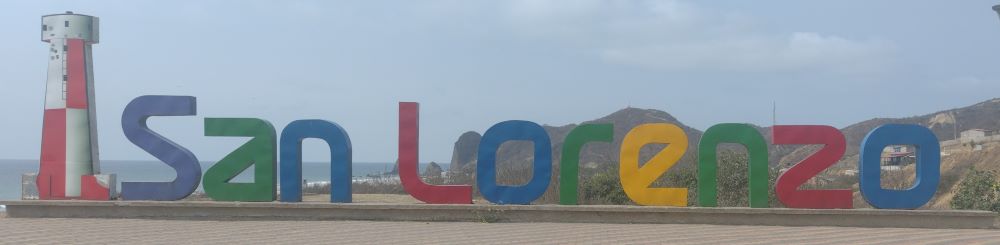
San Lorenzo, Ecuador
December 18, 2022
San Lorenzo, Manabí, Ecuador: I've been searching for any kind of historic info about San Lorenzo and cannot find anything, the few websites that have any info simply talk about the beaches, the lighthouse, the waterfall, the caves, cliffs, etc. I did find that the population is/was (in 2010) about 2600. San Lorenzo is a tiny coastal village, it has no stoplights, no gas station, no supermarket, and no ATM. Here at the Lookout Beach Hotel where I'm staying, the owners are Canadien and very friendly and helpful. They've been here in San Lorenzo for 8 years. They bought this piece of land and built their home on it. Then they added two more floors to open the hotel. Then they added a second building of 3 floors as well as a pool. Now they're in the process of building a restaurant. I highly recommend Lookout Beach Hotel to any travelers visiting San Lorenzo, Manabí.
San Lorenzo has a famous lighthouse, and there's a road that goes almost all the way up to it. You can drive up and park and then walk a few minutes to the top and get some spectacular views. If you require any kind of walking assistance you won't make it to the top, the trail is in dire need of maintenance and has some missing steps, and is fairly steep in places. At the far end of San Lorenzo Beach, there are a few tall rocks, one of which has a couple of caves running through it. During low tide, you can pass through them. Near here is also the starting point of the trail to hike up to the lighthouse. The trail makes a loop and connects to a parking lot on the opposite side. I've seen one website that mentioned there are 800 steps in the trail from the beach up to the top. I haven't verified that count.
There's another trail that can be hiked into the hills and in about 15-20 minutes you're at a waterfall, provided there's water flowing. From the same parking lot trailhead, the road coming up from town continues to the other side of the lighthouse rock and to the La Botada beach. But, there is also a dirt road from that same parking area, which goes up into the hills. I hiked that road. According to Google maps the waterfall is a short distance up and to the right off of the dirt track. I followed the route Google shows to get to the waterfall and it was a dead-end. Eventually, somewhere around the top of the hill, the trail is cut off by fences. I know Google maps has as many inaccuracies as it does correct places when it comes to countries of than North America, so I wasn't surprised it was wrong about this as well. At any rate, if you choose to do that particular hike, know this—it's strenuous. You'll need good hiking shoes and water. Back at the beginning of the trail at the parking lot, the trail is a dirt road that appears to get some use. I think it is by following this road into the hills and not the hiking trail that one would find the waterfall. I also heard from a local that there are howler monkeys in that area. I found out from a local that the trail to the waterfall is not the trail from the lighthouse parking lot, but rather, a trail that starts up the road from the church and runs alongside someone's home as it goes up into the hills. I found the trail, it's actually the dry river bed where you start. You'll walk up a ways, probably 7,8 minutes, and the 'road,' as it is, separates from the dry river bed. At about 15-20 minutes you'll be at the end of the trail and at the waterfall and pond. Way up above is the highway. I found another trail that forks off the main trail. This smaller trail is visible in the satellite view of maps, and it goes up the hill to the highway. I took that trail as well. Rest assured, you will want good knobby-sole hiking shoes. My new Saucony shoes are not hiking shoes, they're for walking on roads. Even though they have a decent enough sole, they were sliding backward while I was going up the last 30-40 feet of the climb, on my hands and knees because it was so steep and slippery (soft sandy/gravelly soil). One at the top I returned to town via the highway, which was actually the faster route.
San Lorenzo Beach is also a protected area for sea turtles, they lay their eggs on the beach. The areas with eggs are marked by simple structures to block people from walking over them. From the top of the hill at the lighthouse the view is spectacular. On one side you see the entire village, on the other side another long and deserted beach. That other beach is called La Botada. The road to the parking lot continues to La Botada beach. I recommend you visit that beach as well but do so at low tide. Chances are you'll be alone exploring it.
As for hotels and restaurants, there are a few hotels/hostels here so finding a low-priced place to spend a few nights is easy. There are very few restaurants— Three along the beach and one very small (3 tables) restaurant 1 block off the beach. I also found one street vendor bbq'ing chuzos, wings, and also making salchipapas and pollopapas. That's it for restaurants.
So, my impressions: So, as you just read, it's a village. To do your grocery shopping you have to drive to Manta, maybe a half-hour or a bit more depending on where in Manta you want to go. For fresh fruit and vegies there is a vendor who drives through town 3 days a week in a pickup loaded with produce. Like the other coastal Ecuador towns, the climate is unbeatable, with year-round pleasant summer temps. I like this little village, but for a place to live, I would like one supermarket and an ATM.
This is my goal: to find a new place to live. So to reach that goal I am traveling most of South America, visiting the countries of Ecuador, Perú, Bolivia, and Chile, passing through Argentina, visiting Paraguay, passing through a bit of Brazil, and finally visiting Uruguay. I have a list of towns, about 70 towns, that meet these qualifications: Cities with average day temperatures of 22-28° C (72-83° F) and night temps of 14° C (57° F) and higher; and a population between 28,000-300,000. I analyzed climate and population data of around 700 towns in the above-mentioned countries and then pulled out the ones that meet the previously mentioned criteria, which leaves about 70. My preference leans towards towns of less than 100,000 people. Of the 70 towns, about 20 have populations of 100,000 - 300,000. And, now that I've been here on the coast for a few days I've decided I will probably want an inland town. I love the beach and walking in the warm water, but, getting sunburned is just too easy, even on a cloudy day. At least, here in Ecuador. I've also decided that any town with more than 100,000 population will be too big. I've decided that any small town that meets the temp specifications and has a supermarket and ATM is one worth considering to live in.
At this point in my journey I have two towns on my top-20 list - Jipijapa and Montecristi.
Next up: Puerto Lopez.

I used to teach English as a foreign language in Barranquilla, Colombia. Now I'm retired and traveling throughout South America.
I'm from Kennewick, Washington, USA. In my previous life, as I call it, I was an IT guy, systems administrator, computer tech, as well as a shipping/receiving guy and also worked as a merchandising guy in a RV/Camping store.